

Portfolio segmentation
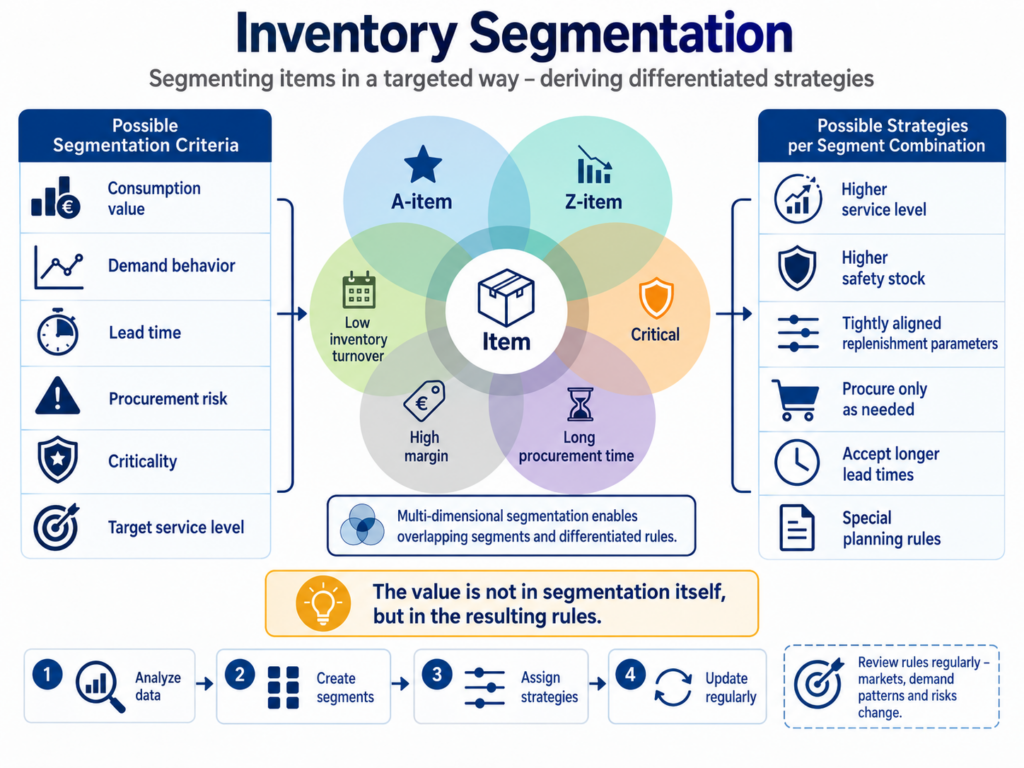
Inventory segmentation refers to the division of an item portfolio into groups to which different inventory, replenishment and service level strategies are to apply.
Such segmentation can be carried out, for example, on the basis of turnover or consumption value, consumption patterns, lead time, procurement risk, margin, criticality or desired availability. The well-known ABC/XYZ analysis is therefore a possible basis for stock segmentation, but does not in itself constitute stock segmentation in the strict sense.
What is crucial, rather, is that different planning decisions are drawn from the segments formed.
For example, it may make sense to stock a high-turnover item in regular demand with a high service level and closely coordinated replenishment parameters. In the case of a C-item in sporadic demand, however, a lower target service level, procurement only when there is a specific need, or even the deliberate acceptance of longer delivery times may be more economical.
Our tip:
Do not segment your items simply for the sake of segmentation. Dividing items into ten or twenty groups serves no purpose if the same forecasting methods, safety stock levels, service levels and planning parameters are subsequently applied to all groups.
Meaningful stock segmentation must therefore always be linked to specific rules for each segment.
Do not limit yourself to one-dimensional segmentation. In practice, several criteria often need to be taken into account simultaneously. For example, an item may be an A-item, a Z-item, strategically critical, difficult to store and dependent on a supplier with a long lead time. Depending on which characteristics apply, a different stock and replenishment strategy may be required.
It therefore makes sense to use multi-dimensional and overlapping segments, each of which is assigned specific rules. Modern rule-based systems, such as DISKOVER’s Rule Set Engine, make it possible to map such interrelationships via rule sets and decision tables, maintain consistency, and derive differentiated planning, control and replenishment parameters from them.
You should also take care not to consider only the value of an item. A C-part may appear economically insignificant yet still bring an entire production line to a standstill. Conversely, a high sales value justifies al