Net Working Capital
By optimising the supply chain, you reduce capital commitment and thus increase net working capital.
Return on investment
Our solutions increase your return on investment by reducing inefficiencies in the supply chain and minimising tied-up capital.
Earning power
By optimising your supply chain processes, you can improve your company's profitability thanks to a faster response to market changes and more efficient use of resources.
Risk minimisation
Our supply chain solutions, verified in advance with empirical data, help you to minimise operational risks and ensure a more stable, predictable business performance.
Competitive advantages
Increase your competitiveness with an agile supply chain that enables you to react quickly to market changes and seize new business opportunities.
Sustainability
Implement sustainable supply chain practices that not only protect the environment, but also contribute to the positive perception of your company and create long-term value.
Solutions for critical challenges
We develop sophisticated but pragmatic supply chain solutions to some of the most pressing and complex supply chain management issues facing companies today.
Our aim in working with you is to find sustainable solutions to the challenges you face in managing your supply chains. We rely on an analytical approach, digital methods, proven skills and – what is very important to us – many years of practical experience.
Answers to complexity
- Defining and effectively implementing successful logistics business models
- Optimization of global and dynamic value chains
- Increasing the return on investment in expanding global supply chains
- Increased efficiency and effectiveness through automation
- Logistical optimisation of the product portfolio to increase profitability





























Services in detail
- All
- Finance & Controlling
- IT
- Purchasing & Procurement
- S&OP

Value chain update

Strategic potential analysis and feasibility assessment

Inventory and delivery readiness management

Forecast optimization and Sales & Operations Planning (S&OP)

Logistics product portfolio analysis and optimization

ERP and APS Optimization

Integrated planning and control model

Logistics controlling and data quality
Optimisation of the supply chain through the use of a "digital twin"
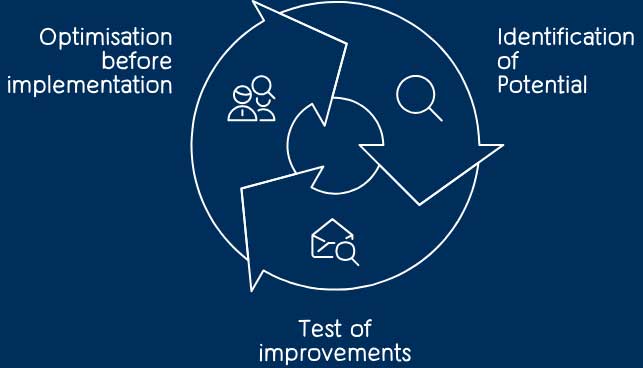
Simulation has proven to be an excellent tool for uncovering potential in your supply chain, identifying improvement measures and testing and optimising them in advance before they are implemented in ongoing operations:
Using empirical simulation, we bring the optimisation potential of your supply chain management to light and replace the fog of gut feeling with clear facts and benefits
FAQ – Frequently Asked Questions
Why is supply chain optimization a management responsibility?
The supply chain affects capital tied up in inventory, costs, delivery performance and overall business success. Optimizing it often requires decisions across departments, such as setting service targets, reviewing the product portfolio or approving investments. Management defines the business priorities and enables sales, procurement, production and finance to work toward shared goals.
How does supply chain optimization improve working capital and liquidity?
Inventory ties up cash that is unavailable for other purposes. Targeted inventory optimization can reduce this investment and release cash. Inventory targets, demand and service levels need to be aligned. The aim is to reduce excess stock while maintaining the supply reliability required by the business.
How can an optimized supply chain improve profitability?
An optimized supply chain can reduce storage costs, planning effort, expedited transport and other avoidable process costs. A logistics-focused product portfolio analysis also helps identify costly or unprofitable variants. Better product availability can support sales. Your data and cost structures provide the basis for assessing which measures offer the greatest financial benefit.
How can supply chain investments be prioritized economically?
A strategic potential analysis identifies the measures with the greatest expected business benefit. We assess anticipated savings, required investment, implementation effort and risks together. This gives management a basis for prioritizing both near-term improvements and longer-term investments according to their value and feasibility.
How does a digital twin support strategic supply chain decisions?
A digital twin allows alternative inventory strategies, planning rules or network structures to be simulated before implementation. Management can compare their likely effects on costs, product availability and capital tied up in inventory. This improves the basis for decisions and helps identify risks early. The reliability of the results depends on data quality and model assumptions.
Can supply chain optimization improve competitiveness and sustainability?
Yes. Coordinated planning and control can shorten lead times, improve delivery reliability and enable a faster response to changes in demand. Reducing excess inventory, scrapping and avoidable expedited transport can also lower resource consumption. Economic and environmental objectives should be assessed together so that improvements support the company’s strategy.