

Minimum Order Quantity (MOQ)
The Minimum Order Quantity (MOQ) refers to the smallest quantity of an item that a supplier accepts per order or order line. It is often established for economic or contractual reasons, such as covering order processing, packaging, and shipping costs or meeting specific pricing and freight conditions.
A minimum order quantity is not merely a purchasing condition but also an important inventory planning parameter that directly affects capital tied up in inventory, inventory levels, and product availability.
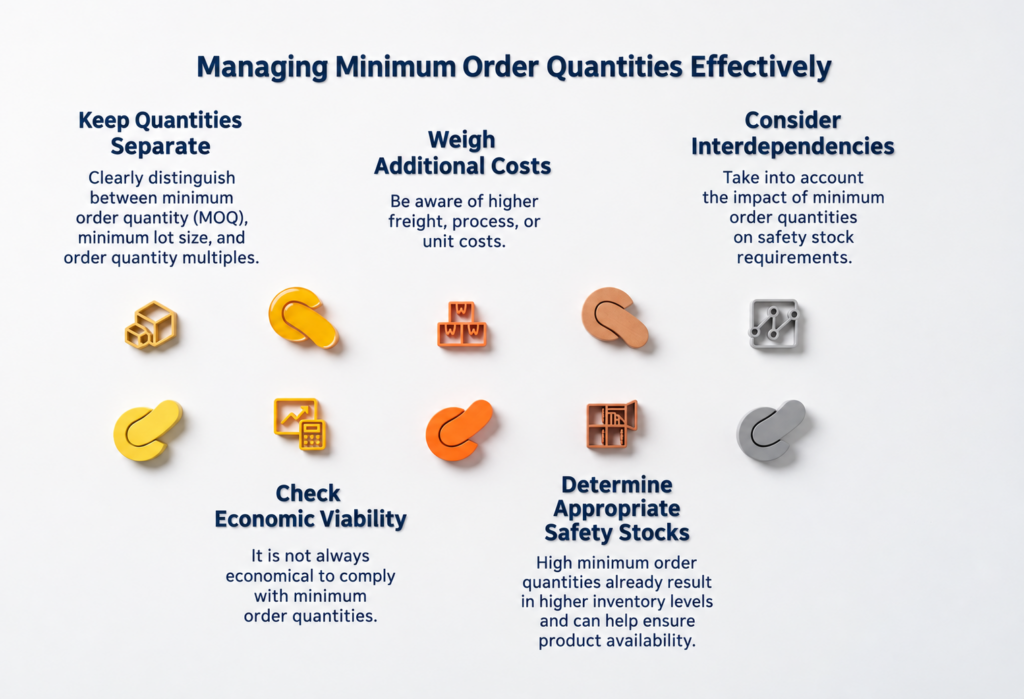
Our Tip:
Make sure to clearly distinguish between minimum order quantity (MOQ), minimum lot size, and order quantity multiples! The minimum lot size defines the smallest permissible procurement or production quantity. It may be determined by technical requirements or packaging constraints, for example. Order quantity multiples, on the other hand, specify the increments in which quantities can be ordered.
The minimum order quantity should be aligned with these requirements and, where fixed packaging units apply, should be a permissible multiple of the packaging quantity.
Regularly review minimum order quantities critically. Complying with minimum order quantities is not always the most economical option. Ordering below the minimum order quantity generally involves additional costs, as freight charges, process costs, or unit prices may increase. However, depending on how regular and predictable material requirements are, it may be more cost-effective to accept the higher price and negotiate smaller order quantities when inventory holding costs, capital tied up in inventory, and scrapping costs are taken into account.
Determine appropriate safety stock levels: High minimum order quantities already result in higher inventory levels and can therefore help ensure the required level of product availability. Consequently, the additional safety stock required may be lower. Advanced APS systems with digital twin technology, such as DISKOVER, can simulate these relationships and optimize safety stock levels while taking order quantity constraints into account. Even without such simulation capabilities, it is important to monitor the impact of minimum order quantities on safety stock requirements.
A minimum order quantity is more than just a purchasing condition. It is a key inventory planning parameter that significantly influences inventory levels, capital tied up in inventory, and product availability.