

Ukraine Speed: Supply Chain Planning Amid a High Pace of Innovation
Which architectural principles make supply chain management adaptable
1. When the pace of innovation outstrips the supply chain
A supply chain does not reach its limits simply because products are being developed at a rapid pace. The situation becomes critical when technologies, components and product variants change faster than development, approval, procurement and production can respond. In such cases, it is not enough to simply speed up individual functions. What matters is how quickly the entire supply chain system can translate a necessary change into a deliverable product. Suppliers must be qualified, tools built, bills of materials approved, stock built up and capacity planned. These tasks take time. The shorter the technical lifespan of a solution becomes, the less time there is to complete them in good time.
The Ukrainian drone industry highlights this problem in an extreme form. Technical solutions are adapted within a matter of weeks, and software in some cases within days. At the same time, it is not just prototypes and small-batch production that are being developed. Production, procurement and distribution are reaching industrial scales. Very short learning cycles and massive scaling occur side by side – even though frequent changes normally make standardisation, stock-building and productivity gains more difficult.
It is precisely this apparent contradiction that makes the case interesting from a supply chain management perspective. It is explicitly not a question of directly applying the structures of a war economy to civilian enterprises. The objectives, risks and decision-making conditions are not comparable. However, the Ukrainian case serves as a useful stress test: it demonstrates which architectural features become relevant when requirements, technologies, available components and operating conditions change faster than traditional development, procurement and production processes can respond.
This presents a specific challenge for supply chain management and supply chain planning: they must simultaneously manage technical changes and industrial scaling. To achieve this, utilisation, development, procurement and production must form short, resilient feedback loops, even under constant pressure to change.
The answer does not lie in maximising speed at every stage. What is crucial is a supply chain architecture that decouples fast and slow elements from one another, connects users directly with development and implementation, selectively scales successful solutions, and coordinates the flows of information, materials and finance. Before design principles for supply chain management can be derived from this, it is first necessary to understand how this system actually functions in Ukraine.
2. The Ukrainian drone industry as a stress test for supply chain management
The development and production of drones in the war in Ukraine is, first and foremost, a military phenomenon. From an industrial perspective, however, what is remarkable is the interplay of several changes: technology, product architecture, procurement, production and utilisation are evolving almost simultaneously. New technical solutions trigger countermeasures; these, in turn, generate a new need for change. The usual time lag between development, industrialisation, mass production and the replacement of a product generation is shrinking dramatically.
This gives rise to closely interlinked cycles: user experiences become drivers of development, product decisions take component availability into account, and procurement and financing support the scaling up of proven solutions. For supply chain planning, this creates the challenge of simultaneously adapting quantities, technical configurations, sources of supply and capacities to new insights. The following section examines how this interplay between learning and delivery works.
2.1 From months to a few weeks
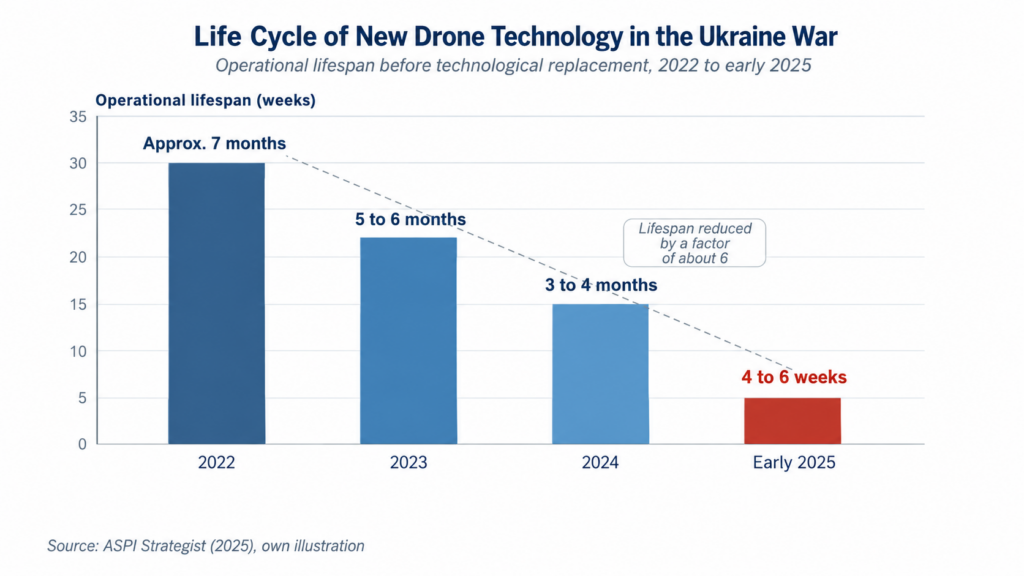
The extent to which this trend has accelerated is illustrated by the data compiled by ASPI Strategist on the service life of new drone technologies. According to this data, the service life was still around seven months in 2022, five to six months in 2023, and three to four months in 2024. By early 2025, some new solutions were reported to have a service life of just four to six weeks. These figures are approximations for a diverse technological field, but they clearly indicate the direction of development.
This does not mean that a drone is physically worn out after six weeks. What is decisive is its technological or operational obsolescence. A solution that is effective today may lose much of its effectiveness just a few weeks later because radio links are disrupted, frequencies are blocked, navigation is impaired or other electronic warfare techniques are employed. The design, electronics, communications or software must adapt to these changes once again.
The service life of a technical solution is thus determined less by material wear and tear or a long-term product generation plan than by the speed at which its environment changes. For traditional industrial processes, such timeframes are unusually short. Even the qualification of a new supplier, the approval of an alternative component or the implementation of an engineering change can take longer than the effective service life of a technical solution.
Furthermore, this acceleration is taking place on several levels. Defence Opinion reports on software patches being issued within 48 to 72 hours and on training materials being updated every two weeks. Such figures cannot be generalised to every drone and every unit. However, they do highlight the fact that software, individual components, operating procedures and complete product versions follow different cycles. It would therefore be misleading to speak of a single innovation cycle for the drone.
2.2 The Seven-Day Loop: usage and development converge
This way of working is particularly evident in the so-called Seven-Day Loop, as described by Exponential View. A technical solution is developed and deployed. Weaknesses or new requirements become apparent during practical use. Users provide immediate feedback on their experiences to engineers. The problem is diagnosed, a modification is developed, and the updated version is deployed again. The cycle of design, use, problem identification, diagnosis, redesign and redeployment can be completed in approximately one week.
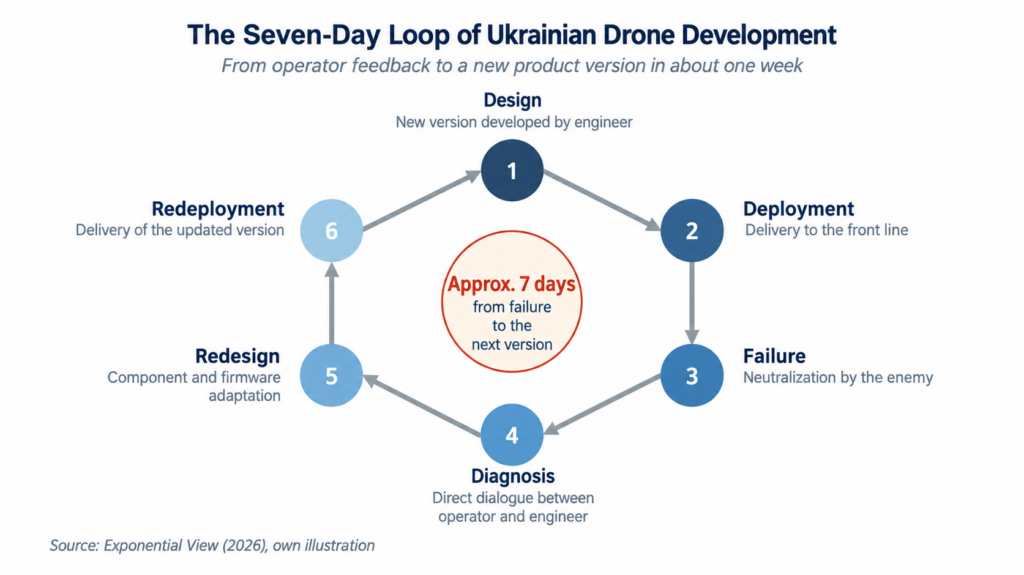
What matters is not so much the exact figure of seven days as the closed-loop relationship between use and development. The user is no longer merely at the end of the supply chain. Their experiences become the starting point for the next product change. Technical changes are therefore not occasional interventions in an otherwise stable product life cycle, but an integral part of the ongoing development and production process.
The ETC Journal describes several interlocking loops: formal product cycles on a monthly basis, operational adjustments on a weekly basis and tactical improvisations on a daily basis. Consequently, the product does not change as a whole at a uniform pace. Different levels of the system learn in parallel – and at different speeds.
2.3 Acceleration and scaling simultaneously
In parallel with the shortening of innovation cycles, Ukrainian drone production grew by several orders of magnitude. Analyses by the Council on Foreign Relations and UAS Feed range from a few thousand units in 2022, through around 600,000 in 2023 and 2.2 million in 2024, to approximately 2.5 to 4 million in 2025; a target figure of around seven million is cited for 2026. At the same time, the number of manufacturers rose from seven to approximately 500. The figures are based on different definitions and should therefore be understood as indicative of the order of magnitude rather than as a uniform official time series.
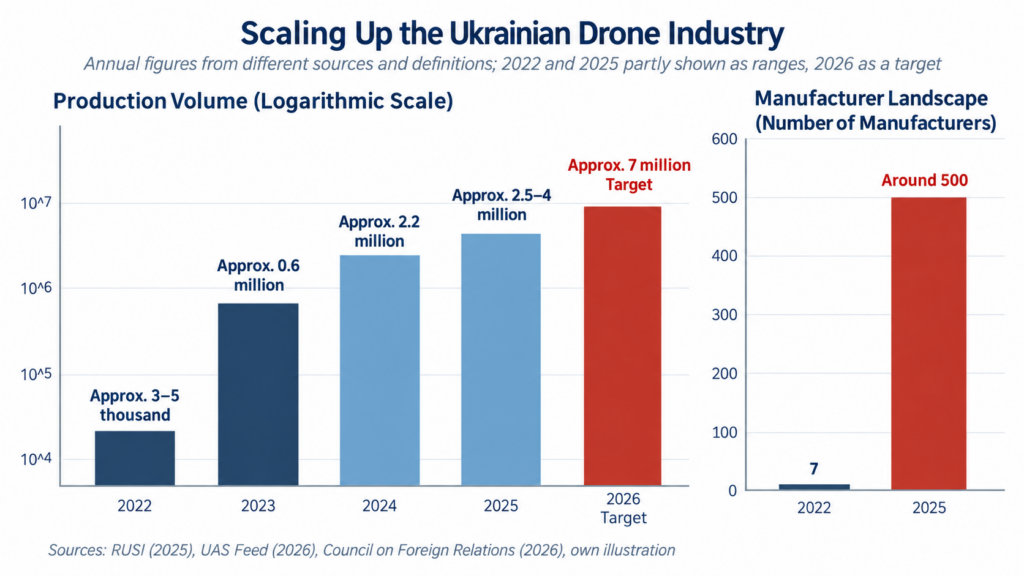
From a supply chain perspective, this simultaneity is the key finding. Frequent technical changes make standardisation more difficult, shorten the economic service life of stock and equipment, alter material requirements and increase the coordination effort required between development, procurement, suppliers and production. Industrial scaling, by contrast, is traditionally based on stabilising products and processes, at least temporarily.
Given this dynamism, one might ask how a production system can deliver millions of units if individual technical solutions have to be modified after just a few weeks? A key part of the answer lies in the fact that not the entire product is innovated at the same pace.
2.4 One product, multiple speeds of innovation
The Royal United Services Institute (RUSI) provides an analytical approach. It considers the dynamics not only at the level of the drone as a complete product, but also classifies the interacting technologies according to their civilian or military origin and their speed of innovation. This results in four categories: rapidly and slowly innovating civilian technologies, and rapidly and slowly innovating military technologies.
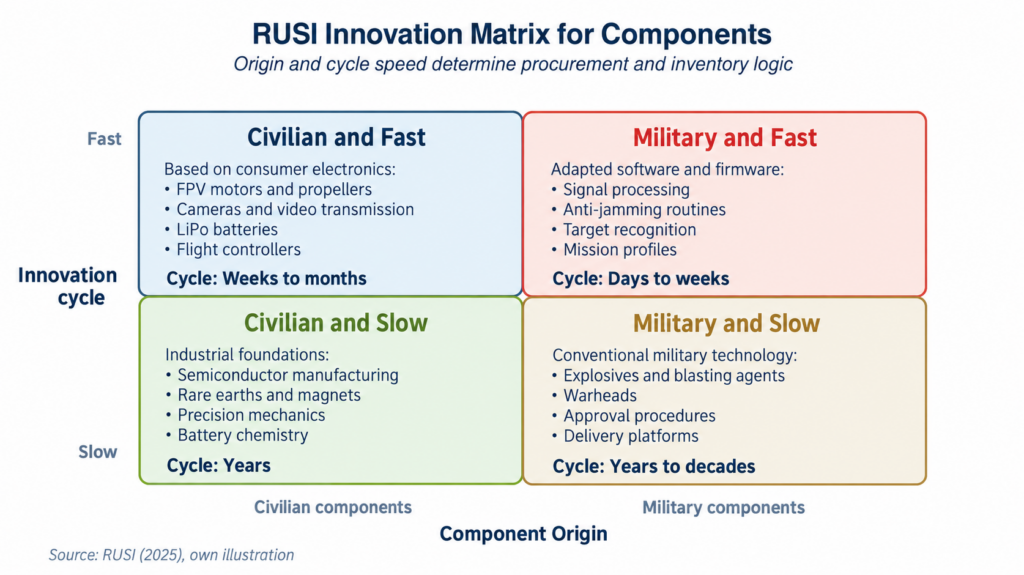
The speed axis is particularly relevant for supply chain planning. Within a technical system, there are very different time constants. A basic mechanical structure can remain stable across many product versions. Radio modules or antennas are replaced within months, whilst firmware is updated within days. Battery cells, semiconductor technologies and communications infrastructures, on the other hand, follow their own investment and renewal cycles.
This overlap makes it possible to partially decouple innovation from scaling. If every improvement were to require a complete redesign of the entire product, weekly cycles and production runs in the millions would be virtually incompatible. If, on the other hand, only the affected modules are modified, other components, supply relationships and production steps can continue as normal. Stability then arises not from an unchanging end product, but from selected stable layers within a changing product.
Consequently, a uniform supply chain logic for the entire product loses its relevance. A safety stock for a mechanical component that survives many versions has a different risk profile to the stock of a radio module with a high risk of obsolescence. Similarly, a long-term contract may be sensible for a stable upstream component, whilst it restricts responsiveness in the case of a fast-moving component.
2.5 A decentralised industrial ecosystem
Product architecture is only one part of the system. According to the Ukrainian Ministry of Defence, the defence industry has evolved from a state-centred model into a flexible ecosystem comprising hundreds of private companies, decentralised production and direct feedback loops between military users and engineers. The case therefore does not describe a single factory, but rather a network comprising developers, component suppliers, integrators, production sites, state institutions and military units.
Decentralisation is not a cost-free benefit. Whilst it can limit concentration risks and facilitate local adaptation, it increases the effort required for coordination, quality assurance, standardisation and data exchange. A large factory can make better use of economies of scale; a network of many production sites can activate new capacity more quickly and compensate for the failure of individual nodes. Which structure makes sense therefore depends on vulnerability, loss of productivity and the possibility of standardised interfaces.
2.6 Digital procurement as infrastructure
With DOT-Chain Defence, this network logic is now also evident at an institutional level. Combat units select the equipment they require themselves on the government marketplace, within allocated budgets. The procurement agency handles contracts, payments and the organisational management of logistics.
On 17 August 2026, the Ministry reported that more than 1.2 million drones and other items of equipment had been delivered during the first year of operation. At that time, units were able to choose from 1,181 systems supplied by 300 manufacturers. The platform complements central government procurement channels; it does not replace them.
From a supply chain perspective, the model links two levels. The decision as to which specific system is procured is made closer to the point of actual use. Within their allocated budget, units can choose for themselves which of the drones and items of equipment available on the platform best meet their current requirements. This means that decisions are not made exclusively by central procurement bodies on the basis of specifications set in the longer term. Rather, the selection process incorporates the experience and priorities of those who actually use the systems.
However, it is only the specific selection decision that is decentralised. Budgeting, the approval of manufacturers and products, contract management, payment and the organisational support for logistics remain part of a centrally provided infrastructure. The central level therefore has less say over each individual order. Its task is to create the financial, legal, digital and logistical framework within which many decentralised procurement decisions can be made quickly, in a controlled manner and in accordance with uniform rules.
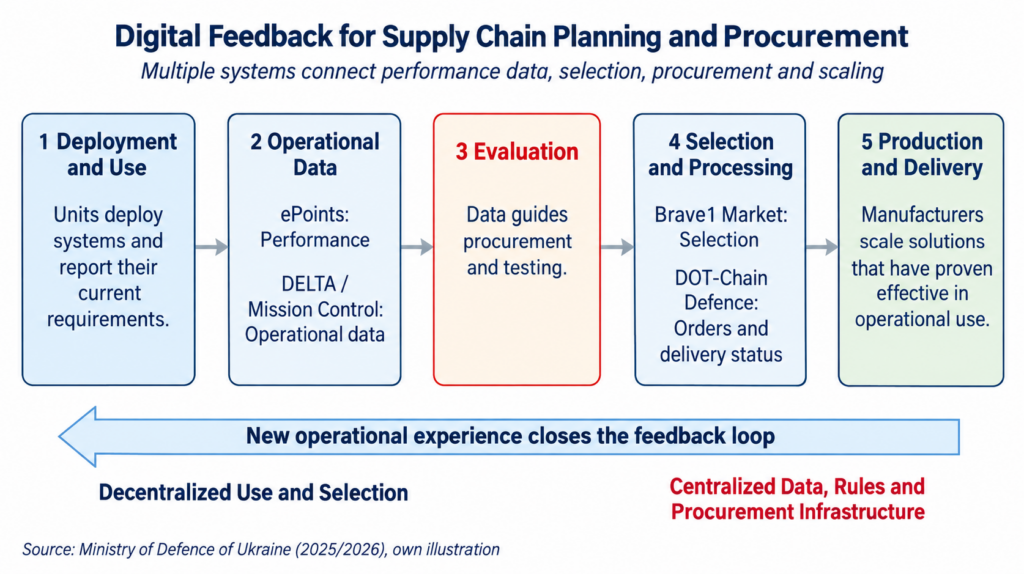
Since March 2026, the Ukrainian Ministry of Defence has outlined a further step: in future, data from several digital systems is to be incorporated into the evaluation and selection of unmanned systems. These are not exclusively marketplaces, but rather various stages of a digital information chain. ePoints provides data on the systems’ proven effectiveness in operational use. The Brave1 Market is a digital product catalogue through which military units can select available drones and other equipment. DOT-Chain Defence supplements this with information on orders, delivery status, logistics and digital documents. DELTA is a secure digital operational environment into which Mission Control is integrated as a command, control and data acquisition system for drone operations. Operational details such as drone type, launch point, flight route and mission brief are recorded there. Taken together, this data shows not only which systems were requested and ordered, but also which were actually deployed and have proven themselves under real-world conditions.
On this basis, and in accordance with the units’ requirements, the General Staff compiles the procurement list; the agency then contracts for the selected systems.
The proposed allocation of resources is also noteworthy: 80 per cent is to be allocated to solutions that have proven their worth according to the system data; 20 per cent is reserved for new developments and their testing. This means that experimentation and scaling are not treated as successive phases. They run in parallel, but are subject to different budgets and decision-making criteria.
A second signalling system is established alongside the forecast for planning purposes. A forecast indicates the quantities likely to be required. Usage and performance data show which product variants should continue to be procured, modified or phased out. Only by combining these two types of signal is it possible to manage both quantity and technical configuration jointly.
2.8 Financing becomes part of the scaling logic
Even an effective product, an available bill of materials and confirmed demand do not automatically lead to rapid scaling. Manufacturers must procure materials, fund staff and build up capacity before delivery is paid for. If working capital becomes the bottleneck, orders and information flow faster than production.
DOT-Chain Defence therefore announced an advance payment mechanism in April 2026. Manufacturers with at least three months’ continuous participation on the platform and no outstanding obligations can receive advance payments depending on their actual delivery performance: up to 70 per cent for an average delivery time of no more than 30 calendar days, and up to 30 per cent for longer delivery times. The funds are made available for 60 days. The stated aim is to provide working capital to enable a faster increase in production.
This makes financing an explicit part of the supply chain architecture. The system’s responsiveness depends not only on how quickly information and materials flow; it also depends on whether payment terms and the provision of capital keep pace with the desired scale.
3. Why adaptability is a characteristic of the entire supply chain system
The characteristics described so far do not, on their own, explain the speed of the Ukrainian drone industry. Neither short development cycles nor digital procurement, decentralised production nor modular product structures are sufficient in isolation. For supply chain management, the crucial factor lies in their interconnection. Only through this can supply chain planning translate new insights into revised procurement, production and delivery decisions in a timely manner.
Feedback from operational use is quickly incorporated into development decisions. Product modifications take into account the availability of components and production capacity. Digital systems link operational data with selection and procurement decisions. Proven solutions are granted access to materials, capacity and funding so that they can be rapidly produced in larger quantities.
However, the conflicting objectives do not disappear. Decentralised decision-making brings decisions closer to actual needs, but requires shared data, budgets and rules. Parallel experiments accelerate learning, but initially increase technical diversity. Modular product structures facilitate change, but require stable interfaces and standards. The system must therefore organise both agility and stability simultaneously.
Rapid development is of little use if approval, procurement, production or financing cannot keep pace. For supply chain planning, it is therefore not enough simply to speed up planning cycles. What matters is the time taken from the identification of a need for change to a solution that has been technically approved, materially supplied, financed and ready for delivery.
This raises the question for supply chain management as to which fundamental rules the supply chain system must be designed according to, so that its elements can interact effectively amidst a high rate of change. These rules are described in the following chapter as architectural principles.
4. Eight architectural principles for adaptable supply chains
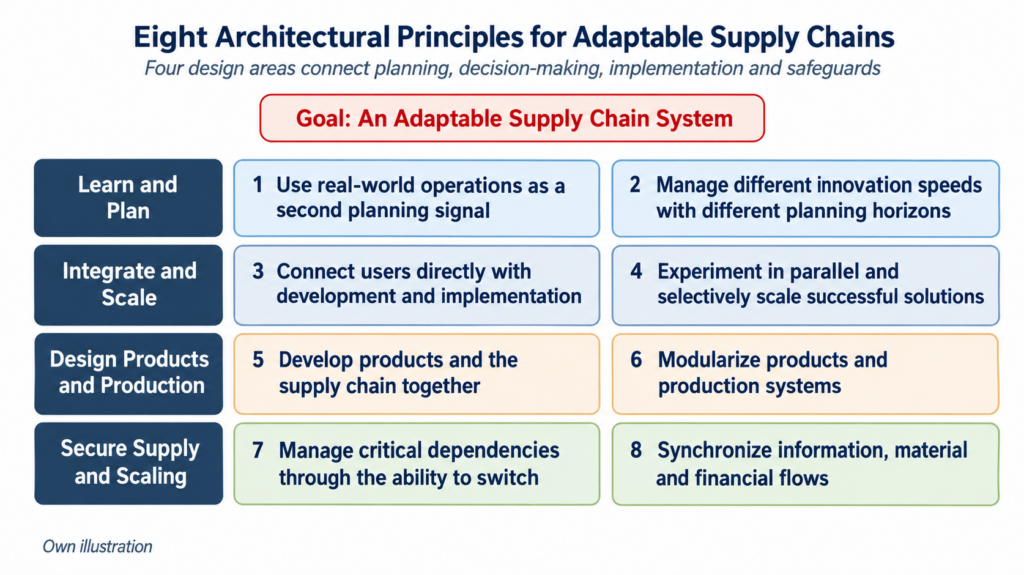
Eight design principles for adaptable supply chain management can be derived from the way the Ukrainian system operates. They illustrate how product structures, decision-making authority, data flows, procurement, production and financing must be coordinated so that supply chain planning remains effective even in the face of rapid innovation. The term ‘architecture’ therefore does not refer to a separate concept distinct from supply chain management. Rather, it describes the structural design of the latter.
The principles deliberately extend beyond planning in the narrower sense. Supply chain planning can only react to new information as quickly as approvals, sources of supply, production structures and financing allow for the necessary adjustments. The following overview categorises the eight principles according to their functions within the supply chain system. The subsequent sections explain their implications for planning and management.
4.1 Real-World Use Becomes a Second Planning Signal
Traditional planning starts with expected demand. Historical data, market information and known requirements are used to determine what quantities will be needed and when. In a highly dynamic technological environment, this signal alone is insufficient. Even an accurate volume forecast can lead to the procurement of the wrong components if the planned technical configuration has already become obsolete.
A second information loop must therefore complement the forecast. Data from real-world use reveals which products work, what failures occur and which technical changes are needed. The forecast continues to answer the question of quantity. The feedback loop, by contrast, answers the question of configuration: What technical versions will need to be procured and produced in the future? These two signals complement each other; neither replaces the other.
For supply chain planning, this means that feedback from service, application, quality and operations must influence decisions without having to pass through lengthy product improvement programmes first. It must be able to inform bills of materials, sourcing decisions, inventories, production plans and phase-out decisions within a short period. What matters is the total response time from identifying a problem to having a modified solution ready for delivery.
However, this principle requires a reliable data foundation. Individual cases, subjective preferences and inconsistently recorded user experiences must not translate into procurement decisions without scrutiny. Clear effectiveness and quality criteria, comparable data and defined rules are needed to determine when feedback should trigger a technical or planning change.
4.2 Manage Different Innovation Speeds with Differentiated Planning Horizons
A complex product does not necessarily have a single, uniform life cycle. Mechanical systems, electronics, communications, software and upstream technologies evolve at different rates. Managing the entire product with one planning horizon and one inventory policy therefore means treating stable components too much as short-term items and rapidly changing components too much as long-term items.
Planning must consequently distinguish more clearly between technological layers and rates of innovation. For components that remain stable across several product generations, longer-term contracts, larger lot sizes or strategic inventories may make economic sense. For components with a high risk of obsolescence, shorter commitment periods, smaller lot sizes, flexible sourcing options and close coordination with development become more important.
The pace of innovation must not be confused with replenishment lead time. A component may change rapidly from a technical perspective even though building the capacity to manufacture it requires long lead times. Conversely, a stable standard part may be available at very short notice. Choosing the right strategy therefore requires considering at least the rate of technological change, replenishment lead time, market availability and substitutability together.
Adaptable supply chain planning does not mean planning everything over shorter horizons. It means managing different rates of change through appropriate planning horizons, replenishment rules and decision frequencies. Stable components secure supply and support scaling. For rapidly changing components, commitments must be limited so that they do not constrain the next product generation.
4.3 Connect Users Directly with Development and Implementation
There are often numerous organisational handovers between a user’s experience and an implemented product change. Service, sales or product management teams collect, assess and prioritise feedback before development works out a solution. Approval, procurement and production then follow. Each of these tasks may be necessary. However, if they are handled sequentially through lengthy coordination chains, the response may take longer than the technological change cycle itself.
The close feedback loop described in Ukrainian drone development therefore suggests an organisational principle: Users must be able to work directly with those who develop technical changes and are responsible for implementing them. Users do more than report a requirement. They help others understand problems, assess potential solutions and test adapted versions under real-world conditions. The user thus becomes a participant in the ongoing development process.
For civilian businesses, this means closely connecting selected customers, users or service personnel with development, quality, procurement and production planning. Simply passing feedback on more quickly is not enough. It must be clear who jointly assesses it, decides on an adaptation and tracks its implementation until the revised product is ready for delivery. Short communication paths achieve little if every decision still has to pass through the same lengthy approval chains.
This proximity to users does not replace shared standards. Quality requirements, technical approval criteria, data structures and budget limits remain the binding framework. Within that framework, participants need clear decision-making authority. Not every customer preference should trigger a new product variant; decisions must remain grounded in substantiated requirements and technical and economic viability.
The task for supply chain management is to embed this feedback process within the organisation. Supply chain planning must be involved early so that material availability, inventories and capacity are considered when a change is first assessed. What matters is not how quickly customer feedback reaches development, but how quickly it results in a tested improvement that is ready for delivery.
4.4 Experiment in Parallel and Selectively Scale Successful Solutions
Innovation requires different approaches to solving a problem. Scaling requires deciding which of them will receive materials, capacity and funding. Under high uncertainty, committing early to a single technical solution would be risky. Equally, not every variant can continue to be developed and produced indefinitely. The Ukrainian model therefore combines parallel testing with selective scaling. New solutions are given room for testing, while proven solutions receive the larger share of procurement funding.
This principle separates exploration and scaling organisationally without making them entirely sequential. Several approaches are developed or tested in parallel. As soon as reliable operational data becomes available, materials, capacity and orders are concentrated on those variants that prove effective under current conditions. Experimentation remains possible because a dedicated share of resources is reserved for it.
Supply chain management and supply chain planning must support both modes of operation. Experimental solutions need small lot sizes, rapid sample procurement, flexible suppliers and short approval processes. Scaled solutions need standardised bills of materials, secured capacity, reliable quality processes and robust supply. Mixing these two approaches makes experimentation too cumbersome or series production too unstable.
Selective scaling also requires decisively discontinuing variants. Solutions that are technically unsuitable or not viable at an industrial scale must not continue to tie up materials, inventory and capacity indefinitely. Clear termination criteria are needed. Otherwise, the number of parallel variants keeps growing, inventories become spread across more and more configurations, and apparent flexibility turns into unmanageable complexity.
4.5 Develop Products and the Supply Chain Together
In sequential development processes, a product is first designed from a technical perspective and then prepared for industrial production. Procurement and production teams must subsequently implement design decisions that have already been made. With short innovation cycles, this approach becomes too slow. A technically compelling solution cannot become industrially usable in time if critical components are unavailable, their qualification takes too long or production cannot be scaled quickly enough.
Product development and supply chain development must therefore proceed in parallel. Availability, lead times, market structure, manufacturability, quality assurance, ease of modification and scalability must be considered when components and architectures are selected. This does not mean that procurement dictates the technical solution. It means that technical and industrial viability are assessed together.
Design for substitution becomes particularly important here. Interfaces, software and regulatory approval approaches should be designed to allow alternative components to be used with limited modification effort. Similarly, design for manufacturing must do more than simplify current production: It must also enable rapid volume increases and the use of additional production sites.
Once again, the key measure is end-to-end response time. What matters is not how quickly a design is changed, but when that change has received technical approval, has the necessary material supply in place, can be produced and is ready for delivery. Only then does development speed translate into industrial adaptability.
4.6 Modularise Products and Production Systems
Modularity limits the scope of change. A new radio technology should not necessarily require a new mechanical platform, new production equipment and a complete rebuilding of the supply chain. Stable technical interfaces allow rapidly changing components to be replaced while other parts of the product and production system remain in use.
The same principle applies to the production system. Value-adding activities can be designed as interoperable modules that can be distributed across additional sites, supplemented with reserve capacity or replaced in the event of disruption. This requires consistent data models, defined handovers, standardised testing and comparable workflows. Without these standards, distribution merely creates additional process variants.
Nevertheless, a blanket call for decentralised manufacturing would be misguided. Highly specialised processes may offer substantial economies of scale, and distributing them may cause significant productivity losses. Other activities, such as assembly, testing or configuration, may be easier to spread across multiple sites. The appropriate architecture must therefore be assessed separately for each value chain stage, considering its vulnerability and the productivity loss that distribution would cause.
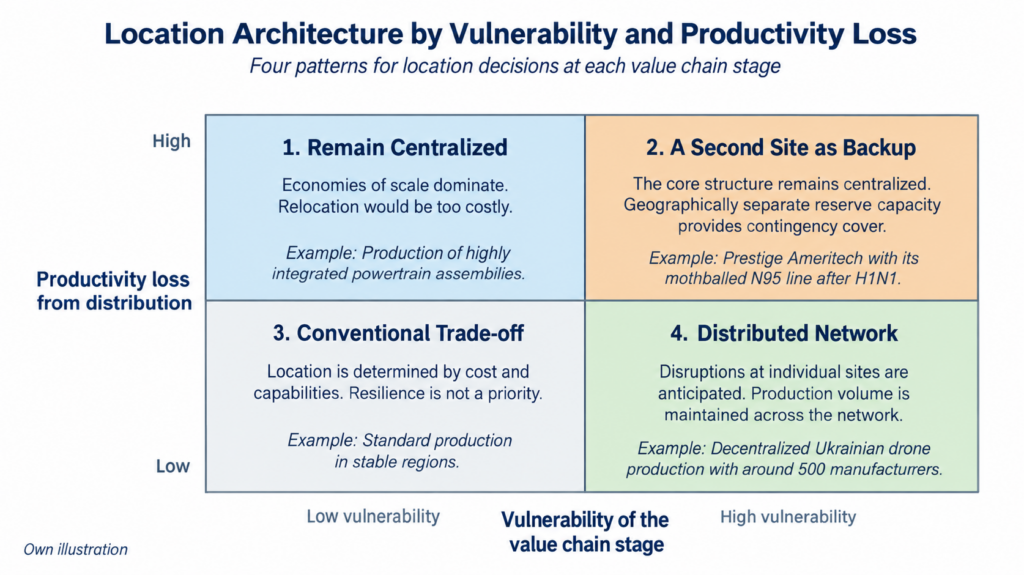
Product modularity and production modularity reinforce each other. The more clearly a product is divided into modules and the more stable its interfaces, the easier it becomes to distribute or replace manufacturing activities. For supply chain planning, this creates opportunities to prepare production alternatives and capacity transfers without allowing every product change to affect the entire network. Modularity thus evolves from a feature of product design into a characteristic of the entire value creation system.
4.7 Manage Critical Dependencies Through Prepared Switching Capabilities
Despite increasing local production, the Ukrainian drone industry remains dependent on internationally sourced components, intermediate products and technologies. Companies do not need to manufacture every critical component themselves. What matters is identifying critical dependencies and keeping technically and commercially prepared alternatives available so they can switch quickly in the event of a disruption.
Not every dependency needs to—or can—be eliminated. The key questions are which dependencies constrain the responsiveness of the overall system and how quickly an alternative can be adopted when a disruption occurs.
Having a second supplier on the supplier list does not, in itself, create the ability to switch. The alternative component must be technically compatible, the supplier must be qualified and the operational preparations for the change must be complete. These include testing, approvals, master data and adjustments to planning and production.
This total period can be described as Time-to-Substitute. It encompasses the time from identifying the need for a replacement through selection, technical adaptation, validation and approval to the actual availability of the alternative component. Delivery lead time accounts for only part of this period. If a supplier can deliver the alternative component within two weeks, but technical validation and approval take several months, those months determine the actual switching time. Particularly in regulated industries, documentation, regulatory approval and requalification can account for the largest share of the total time.
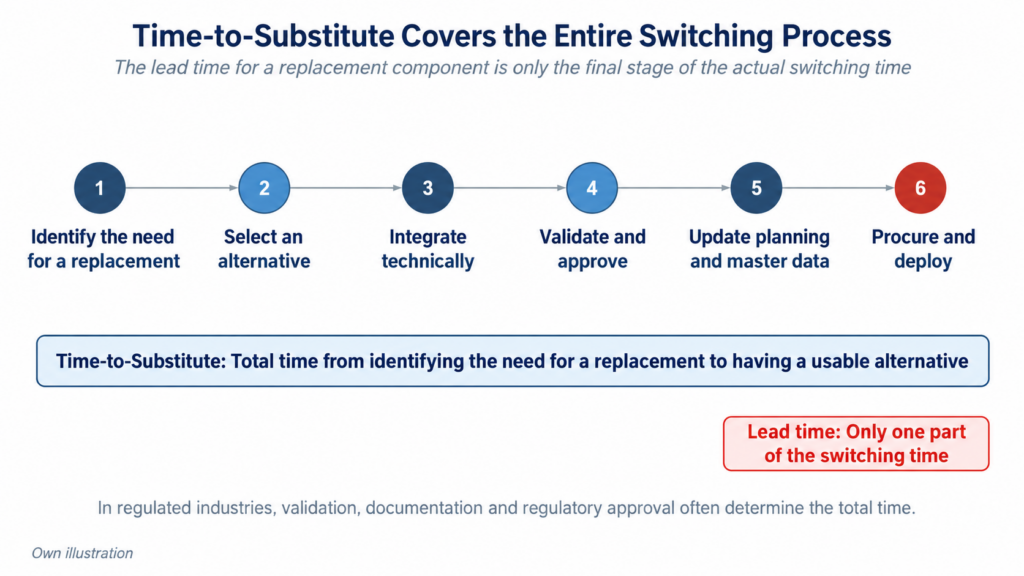
Time-to-Substitute complements traditional resilience metrics. For supply chain planning, it indicates how long inventories or other safeguards must bridge the transition to a viable alternative. Safety stock is sufficient only if it covers this period. The longer the switching time and the greater the criticality, the more strongly supply must be secured through inventory, reserve capacity, contractual commitments or control over supply. The shorter the switching time achieved through advance preparation, the less physical buffer may be required, all other things being equal.
Here, too, fully safeguarding every material would be uneconomical. Components and technologies should be prioritised according to criticality, market structure, innovation speed and Time-to-Substitute. The objective is not maximum independence, but the ability to act when a critical source of supply fails.
4.8 Synchronise Information, Material and Financial Flows
Supply chain architecture is often understood primarily as the design of material and information flows. The Ukrainian case shows that this view is incomplete. A manufacturer may be technically and operationally ready to fulfil an order, yet still be unable to scale because it lacks the working capital needed for materials, personnel or additional capacity.
Money also has a lead time. Between identifying a requirement and delivering additional volume, orders must become firm commitments, financing must be secured, materials procured and capacity activated. Rapid demand information is of little use if investment approval is still pending or a supplier cannot finance the additional materials upfront. Such delays can constrain scaling just as much as missing components or fully utilised equipment.
For planning, this means treating financial constraints as more than annual budget limits. Payment terms, advance payments, credit lines, inventory financing and investment approvals directly influence how quickly suppliers and a company’s own plants can respond to rising demand. A realistic scaling plan must therefore account for the associated financing requirements as well as materials and capacity. Working capital is more than a balance sheet item: A lack of financing can prevent existing capacity from being used or additional capacity from being built.
This principle is particularly important because financial lead times often feature only indirectly in traditional supply chain models. An adaptable architecture synchronises information, materials and money. Only when all three flows support the same scaling path can a signal from the market or real-world use be translated into deliverable volume in time.
The eight architectural principles are interdependent. Operational data loses its value if it does not trigger rapid changes to products and procurement. Modular products offer little benefit if alternative suppliers are not ready. Decentralised decisions do not lead to fast delivery if centralised data, contracts or financing are missing. Industrial adaptability therefore emerges from the consistent integration of these principles.
5. Implications for Supply Chain Planning and Management in Civilian Businesses
The Ukrainian drone industry is an extreme case. Wartime conditions alter priorities, risk tolerance and decision-making processes. Speed can become so important that cost, efficiency and long-term standardisation temporarily take a back seat. This does not justify a general call for seven-day development cycles, highly decentralised manufacturing or platform-based procurement.
What can be transferred is not the absolute pace, but the relationship between the rates of change and response. A supply chain becomes vulnerable whenever product requirements, technologies or components change faster than development, qualification, procurement, planning and industrialisation can respond. Whether this point is reached within a few weeks or only after several years depends on the product, industry and regulatory environment. The structural problem remains the same.
Ukraine Speed thus becomes a stress test for supply chain management in civilian businesses. Companies should not start by asking which Ukrainian tools they could copy. They should examine where their own supply chain architecture delays change or unnecessarily spreads its effects across the entire product and network.
Six questions can help guide this assessment:
Which components, technologies and process layers change, and at what pace?
How long does it take to turn relevant operational or market information into a product change that is ready for delivery?
How are users connected with development and implementation, and what decision-making authority do participants need within shared rules?
Where should several solutions be tested in parallel, and what criteria determine which are subsequently scaled or discontinued?
Which critical components can be substituted, and what is their actual Time-to-Substitute, including approval and operational changeover?
Can order commitments, financing, materials and capacity be scaled up at the same pace?
The answers will differ by industry. In regulated industries, speed must not replace testing and regulatory approval. For capital-intensive processes, distributed manufacturing may make little economic sense. Long-term supply contracts may remain appropriate for stable upstream stages. The architectural principles therefore call for targeted differentiation according to the pressure for change, criticality and economic trade-offs.
The first step is to compare innovation cycles with the company’s own response times. For selected critical components, companies should assess how quickly technical requirements change and how long it actually takes to implement an adaptation that is approved, has the necessary material supply in place and is ready for delivery. Where adaptation takes longer than the relevant change cycle, action is needed. To support this assessment, companies can segment components by their rate of technological change and replenishment lead time, measure the total lead time for engineering changes and determine the Time-to-Substitute for critical components. At the same time, they can distinguish between stable structures that are genuinely necessary for quality, safety and delivery capability and delays that merely result from processes that have evolved over time.
The practical task for supply chain management therefore centres on the interfaces between product modules, approval processes, supplier pools, decision-making authority and financing. These must be aligned so that supply chain planning can contain the impact of changes and scale successful solutions quickly. Not every supply chain needs to become faster in every respect. It needs the ability to adapt wherever its response time can no longer keep pace with changes in markets, technologies or products.
6. Conclusion: Supply Chain Planning Must Plan for Change
The Ukrainian drone industry shows that industrial speed does not come from short development cycles alone. What matters is whether supply chain management can absorb new information, identify its technical implications and translate them into procurement, production and delivery in time. Only a closed feedback loop turns a rapidly developed idea into a scalable solution.
Adaptability does not mean abandoning stability. Change becomes manageable when stable interfaces, standards and product modules limit its wider effects. Stability must enable reliable supply and scaling without unnecessarily slowing down the dynamic parts of the system.
This broadens the role of supply chain planning. It does more than plan quantities, inventories and capacity within a given structure. It must also recognise when that structure needs to change and bring together different planning horizons, prepared alternatives, and information, material and financial flows.
For supply chain management, the response time of the overall system is therefore decisive. Analysing this end-to-end lead time helps distinguish between slower structures that provide necessary stability and those that merely delay change.
The pace of change in the Ukrainian drone industry is an extreme case rather than a directly transferable blueprint. Yet the underlying challenge also affects civilian businesses whenever product, technology or component cycles become shorter than their supply chains’ response times. Under rapid innovation, a high-performing supply chain implements the necessary changes in time for delivery while maintaining reliable supply and economically viable scaling.
FAQ – Frequently Asked Questions
What Does “Ukraine Speed” Mean for Supply Chain Management?
In this article, “Ukraine Speed” describes the interplay between extremely short innovation cycles and rapid industrial scaling in the Ukrainian drone industry. For supply chain management in civilian businesses, it raises a fundamental question: How can technical changes be translated into procurement, production planning and delivery in time? Transferable design principles include modular structures, short feedback loops and prepared alternatives. The military model is not a directly applicable blueprint for businesses.
How Must Supply Chain Planning Adapt to Short Product Life Cycles?
With short product life cycles, supply chain planning must account for technical changes alongside quantities, inventories and capacity. Components require different planning horizons and replenishment strategies depending on their pace of innovation, replenishment lead time and risk of obsolescence. Close coordination between development, procurement and production planning helps prevent obsolete inventory and ensures that new product variants are ready for delivery in time.
Why Are Demand Forecasts Alone Insufficient for an Adaptable Supply Chain?
A demand forecast indicates the quantities likely to be needed. However, it does not fully determine which technical product variant will be suitable in the future. Demand planning therefore needs additional feedback from users, service and quality teams. By combining this information with demand forecasts, companies can make targeted adjustments to bills of materials, material replenishment planning and production plans, reducing the risk of obsolete inventory.
How Can Inventory Be Optimised Amid Rapid Innovation?
Time-to-Substitute is the total time required before an alternative component can actually be used. It includes selection, technical adaptation, supplier qualification, testing, approval and operational changeover. It complements delivery lead time by showing how long safety stock or other measures must bridge a supply disruption. Preparing alternatives in advance can shorten this switching time and improve supply chain resilience.
What Role Do Modular Products Play in Supply Chain Optimisation?
Modular products limit the impact of technical changes to individual components or assemblies. Stable interfaces allow affected modules to be replaced while other product parts, supplier relationships and manufacturing processes remain in use. This supports supply chain optimisation by simplifying material supply, production planning and scaling. It requires consistent data, clear approval procedures and standardised processes across development, procurement, suppliers and production.
Why Must Working Capital Be Considered in Supply Chain Planning?
Working capital influences how quickly companies and suppliers can procure additional materials and expand production capacity. Even when demand exists, a lack of financing can delay delivery. Realistic supply chain planning therefore considers payment terms, financing requirements and investment approvals alongside materials and capacity. Information, material and financial flows must be aligned so that planned growth can be translated into operational results.
