

The Planning of the Future
Why turbulent supply chains require robust decision-making frameworks
For a long time, demand planning was regarded as a routine operational function within materials management. Its remit seemed clearly defined: ensuring material availability, avoiding missing parts and managing stock levels. Yet this view no longer suffices today. In an era of persistently turbulent supply chains, demand planning is increasingly evolving into a strategic management function with a direct impact on capital tied up, delivery capability and competitive stability.
The traditional mechanisms of demand planning are increasingly reaching their limits. Market volatility is on the rise, regulatory requirements are growing, and the complexity of supply networks is increasing faster than productivity and human resources. At the same time, many companies still operate using parameters that have evolved over time, parallel worlds of Excel spreadsheets and heuristic interventions.
Forecasting in the future will therefore not be characterised primarily by greater operational speed, but by more robust decision-making architectures. At the heart of this are clearly defined policies, simulation-based validation, analytical AI support and a new understanding of the role of forecasters.
Inventory Management as a Lever for Profitability
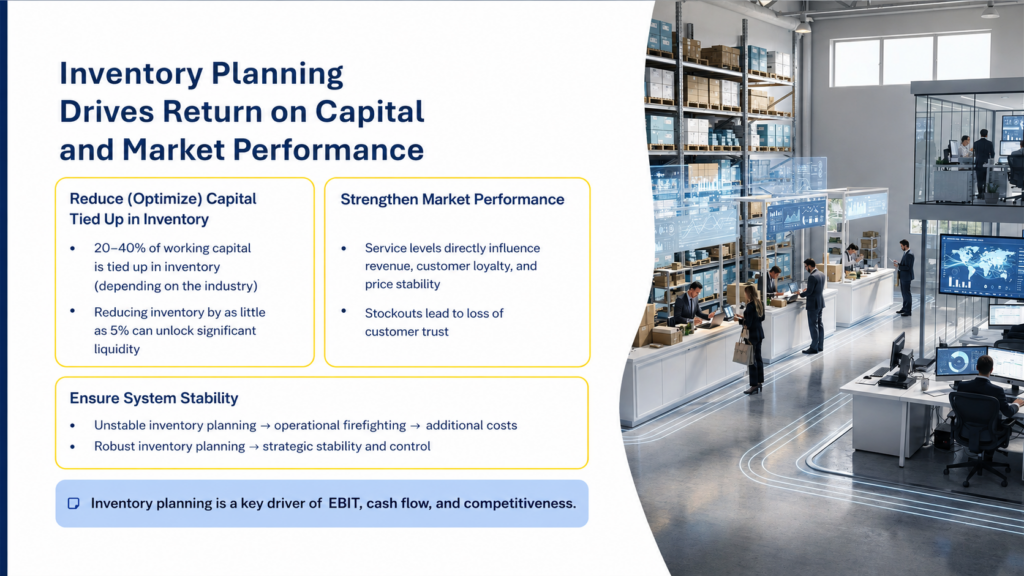
Today, inventory management influences far more than just the flow of materials. It has a direct impact on a company’s financial stability.
In many industrial companies, 20 to 40 per cent of working capital is tied up in stock. Even small reductions in stock can therefore free up significant liquidity. At the same time, the ability to deliver plays a decisive role in a company’s market impact. High service levels stabilise turnover, customer loyalty and price levels, whilst failed deliveries quickly lead to a loss of trust.
Added to this is a third level of impact: systemic stability. Unstable planning creates operational chaos. Short-term interventions for material procurement, special transport arrangements, escalations and last-minute changes in priorities become the norm. Robust planning, on the other hand, reduces the need for operational interventions and creates strategic calm. It improves predictability and reduces indirect costs throughout the entire supply chain.
Planning thus becomes a key lever for EBIT, cash flow and competitiveness.
Turbulence is becoming the new normal
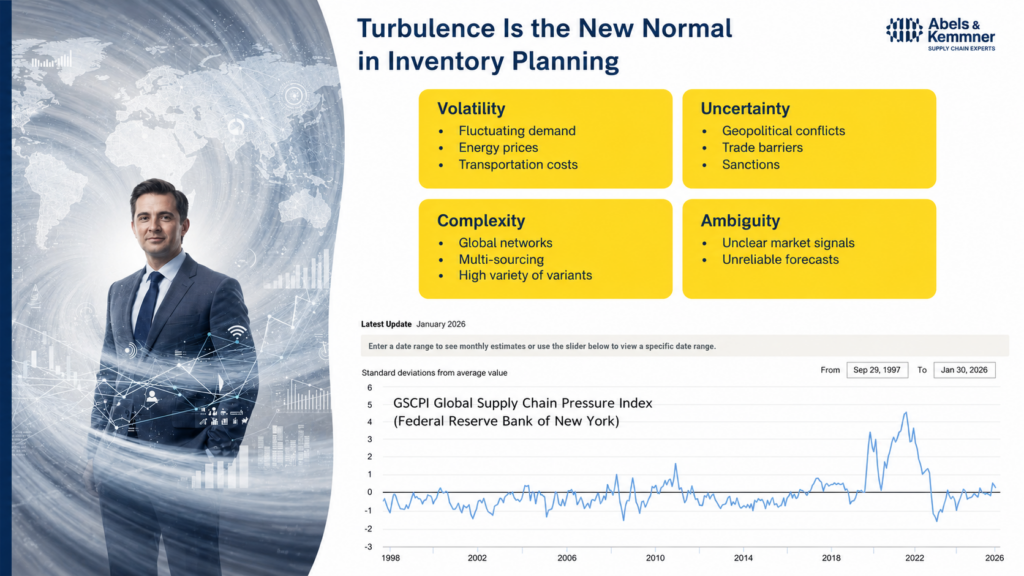
For many years, supply chains operated within a comparatively stable environment. Forecasts were more reliable, lead times more consistent and global networks relatively predictable. Today, this stability has all but disappeared.
Supply chains are increasingly operating in a permanent VUCA environment. Demand, energy prices and transport costs are fluctuating more sharply. Geopolitical conflicts, trade barriers and sanctions are increasing uncertainty. Global networks, product variety and multi-sourcing are adding to the complexity. At the same time, market signals are becoming more ambiguous and forecasts more contradictory.
The key point here is that companies are no longer operating under exceptional circumstances. They are operating in a state of permanent uncertainty.
This development is particularly evident in the bullwhip effect. Small changes in market demand are systematically amplified along the supply chain. A sales fluctuation of just five per cent can trigger adjustments of ten to fifteen per cent in production. In procurement, this often results in fluctuations of fifteen to thirty per cent.
This amplification is not primarily caused by individual errors, but by the structure of the systems themselves. Forecasts are slow to react, safety stocks are built up at several stages, ordering policies vary from department to department, and, faced with uncertainty, organisations tend to err on the side of caution. The bullwhip effect is therefore less a problem of volatility than a problem of architecture. It demonstrates that the decision-making logic along the chain is not robust enough.
Regulatory requirements are increasing the pressure to manage operations
Alongside market volatility, regulatory requirements for supply chains are rising dramatically.
Supply chain legislation, ESG reporting, product-level carbon footprinting, CBAM regulations, sanctions and export controls are fundamentally changing the framework for demand planning. Today, companies must not only manage supply capability and inventory costs, but also take into account risks, reporting obligations and compliance requirements.
As a result, demand planning is evolving into an integrated management function that balances supply capability, capital tied up and risk exposure. These three objectives cannot be optimised independently of one another. Increasing service levels affects stock levels and costs. Reducing stock levels alters risk positions. Ensuring compliance with regulatory requirements often necessitates a reassessment of procurement channels and security strategies.
Traditional approaches are proving increasingly inadequate for this purpose. Safety stock can no longer cover risks across the board. It must be defined in a differentiated, risk-based and dynamic manner.
At the same time, planning cycles are becoming shorter. Decisions must be able to respond more quickly to changes. Furthermore, the importance of scenario-based decision-making is increasing. Companies need prepared alternatives for supplier failures, geopolitical restrictions or regulatory changes.
As a result, demand planning is increasingly becoming about managing a service commitment under conditions of uncertainty.
The structural strain on traditional planning
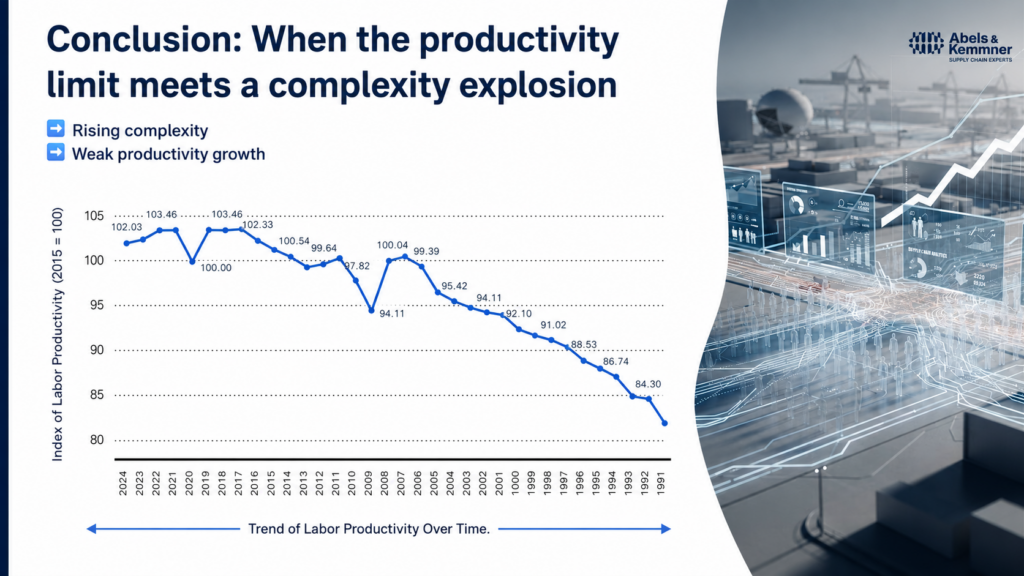
The increasing pressure to manage operations is compounded by a second trend: complexity is growing faster than productivity and human resources.
In many industrial sectors, productivity gains have been stagnating for years. At the same time, demographic change is exacerbating the shortage of skilled workers – particularly within the supply chain sector. In parallel, the number of variants, SKUs, customer-specific configurations, international dependencies, data sets and interfaces is increasing significantly. In many places, the number of items subject to planning is growing faster than the number of planners.
Many companies respond to this with additional manual coordination. Excel analyses, email communication, manual prioritisation and bespoke solutions become part of the day-to-day workflow alongside the ERP system. Formally, the system handles planning; in reality, however, people often carry out planning alongside the system.
These parallel worlds create significant structural risks. Differing data sets lead to a lack of transparency, manual processing increases the likelihood of errors, and implicit experiential knowledge is lost when staff change. This makes decisions difficult to replicate.
Added to this is the fact that many parameter settings have evolved over time. Safety stock levels, lead times and reorder points have been adjusted over the years without systematic revalidation. Individual crises, supply problems or project experiences give rise to permanent buffers, which are rarely consistently reduced later on.
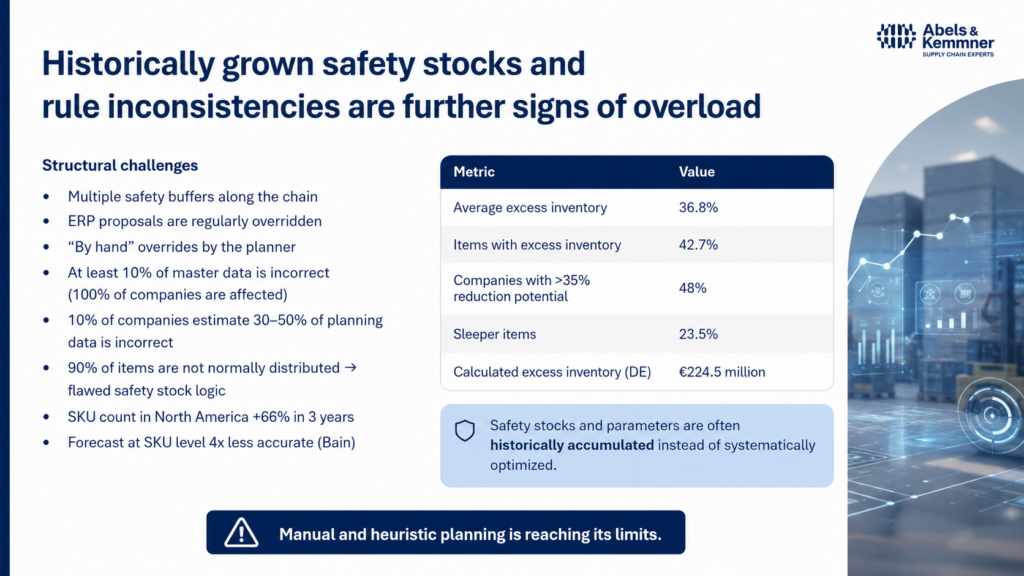
The result is often a creeping build-up of buffer stock. In some segments, excess stock builds up, whilst shortages continue to occur elsewhere. This is not a contradiction, but rather a reflection of inconsistent parameter settings.
A particular problem is that many safety stock models implicitly assume that demand is normally distributed. In practice, however, this applies only to a subset of items. Spare parts, project-related requirements or intermittent demand usually follow significantly more complex patterns.
The consequence is that forecasting errors are increasingly masked by additional stock.
Automation is becoming inevitable
Against this backdrop, it is clear that the existing planning model is reaching its structural limits.
Automation is therefore not primarily an efficiency project, but a response to increasing turbulence, growing complexity, a shortage of skilled workers and inconsistent parameters.
However, there is often a misunderstanding of what automation actually entails. It does not simply mean activating automatic order proposals in the ERP system. Without robust parameters and consistent decision-making logic, this would merely reproduce instability more quickly.
Rather, robust automation requires clear policies, well-defined parameterisation, transparent decision-making logic and continuous feedback between the rules and the results.
Traditional ERP systems are increasingly reaching their limits in this regard. Their logic is fundamentally deterministic: they calculate a plan on the assumption of stable conditions. Yet it is precisely this assumption that loses its validity in turbulent supply chains.
From deterministic planning to robust policy
In stable environments, deterministic planning works very well. You define assumptions, calculate requirements and plan accordingly.
In turbulent supply chains, however, a single optimal plan is no longer sufficient. The crucial question today is not: ‘What is the best plan?’ Rather, it is: ‘How robust does our decision-making logic remain if the assumptions do not materialise?’
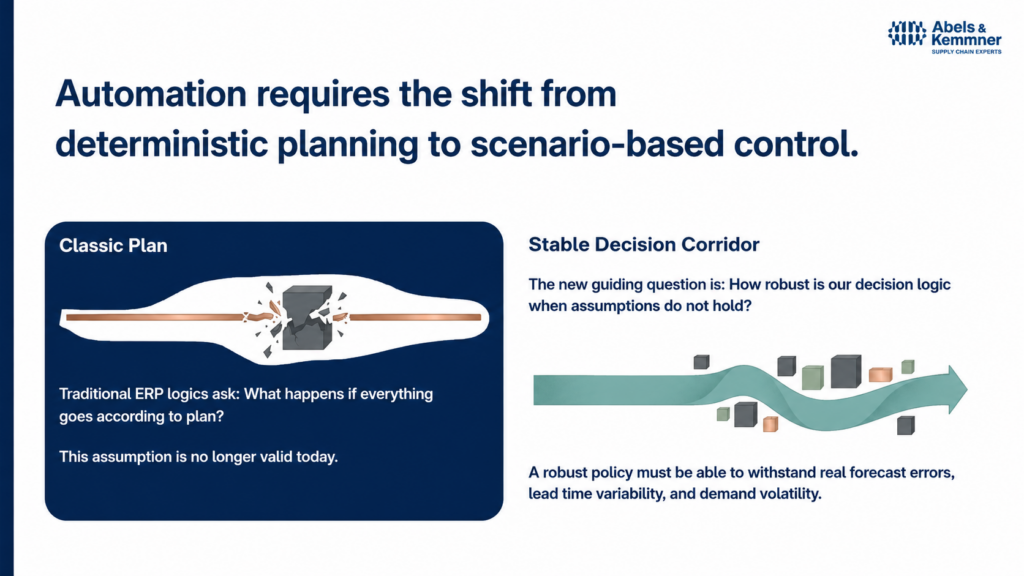
Robust planning must be able to cope with real-world disruptions. These include demand volatility, variations in lead times, supplier failures, capacity shifts and forecasting errors.
This fundamentally shifts the objective of planning. Companies are no longer seeking the theoretically optimal point, but rather a stable decision-making corridor.
In this context, simulation becomes a key validation tool. It does not replace operational planning, but helps to compare scenarios, analyse sensitivities, test combinations of parameters and highlight conflicting objectives.
The key task is to validate policies under realistic disruptive conditions.
AI: Analytical Capability Rather Than Decision-Making Autonomy
Hardly any other topic dominates the current debate as much as artificial intelligence. Expectations range from autonomous scheduling to self-optimising supply chains.
However, many of these visions underestimate a key distinction: the difference between analytical capability and decision-making autonomy.
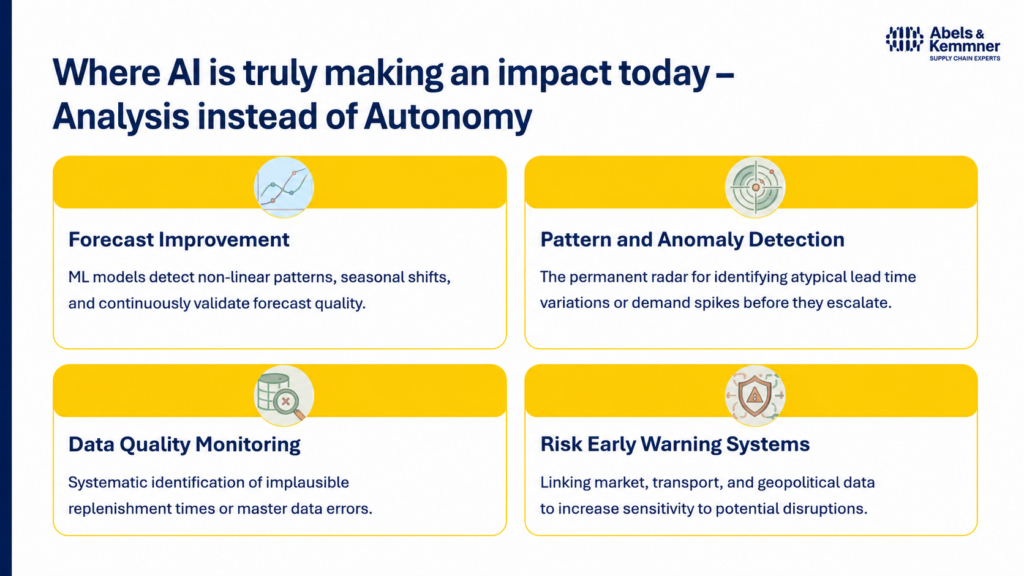
AI is already capable of delivering significant analytical improvements today. It can refine forecasts, recognise patterns, detect anomalies, monitor data quality and act as an early-warning system for risks.
Modern machine learning models, in particular, are often far better at recognising non-linear demand trends, seasonal shifts and structural changes than traditional statistical methods. The ability to recognise patterns also offers considerable benefits. AI can highlight atypical demand trends, unusual variations in delivery times or master data inconsistencies at an early stage.
The real added value lies less in autonomous decision-making and more in transparency and raising awareness.
After all, demand planning remains a normative task. It requires decisions on conflicting objectives: capital versus service, risk versus costs, short-term efficiency versus long-term stability. Such conflicting objectives require explicit policies and governance structures. AI can support this decision-making architecture, but cannot replace it on its own.
The Digital Twin as a validation environment
When robust policies need to be tested under real-world disruptive conditions, a traditional ERP system is no longer sufficient.
This is where the Digital Twin comes into its own.
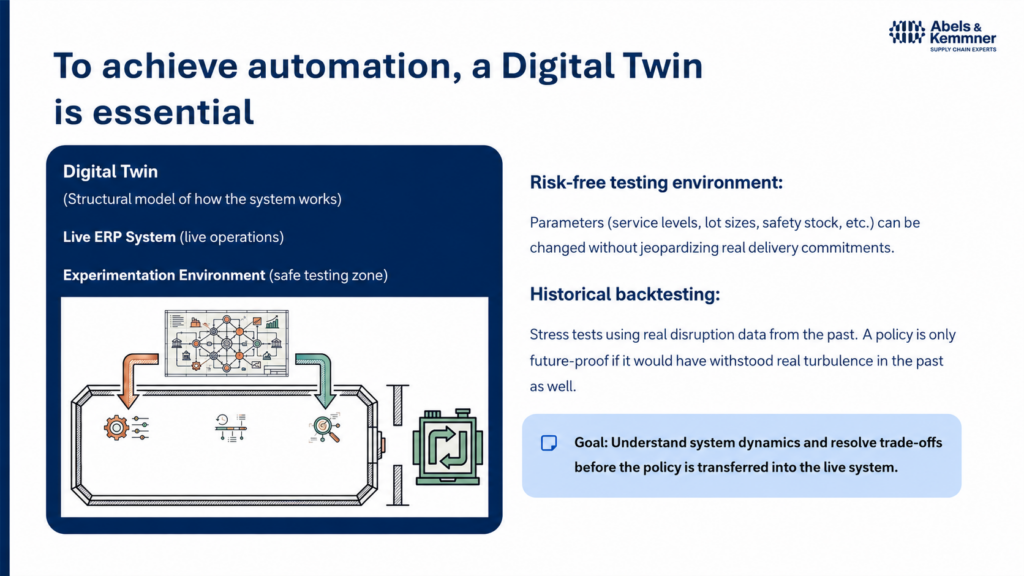
A Digital Twin is neither a dashboard nor a pure reporting system. It maps the real-world supply chain as a parameterisable impact model. It does not merely display data, but models causal relationships: material flows, capacities, constraints, planning logic, cost structures and service targets.
The key advantage is that policies can be tested in a protected experimental environment. Companies can, for example, simulate changes to safety stock levels, alternative batch size strategies, supplier failures, volatile demand trends or capacity constraints.
Historical back-simulation is particularly important here. A policy is only considered robust if it would have functioned stably even under real disruptions that occurred in the past. Forecasting errors, real-world delivery time variations and historical crisis situations are systematically taken into account.
The Digital Twin thereby transforms planning from reactive intervention control into a proactive decision-making architecture.
Simulation is not a continuous process
However, simulation does not mean constantly recalculating every operational decision.
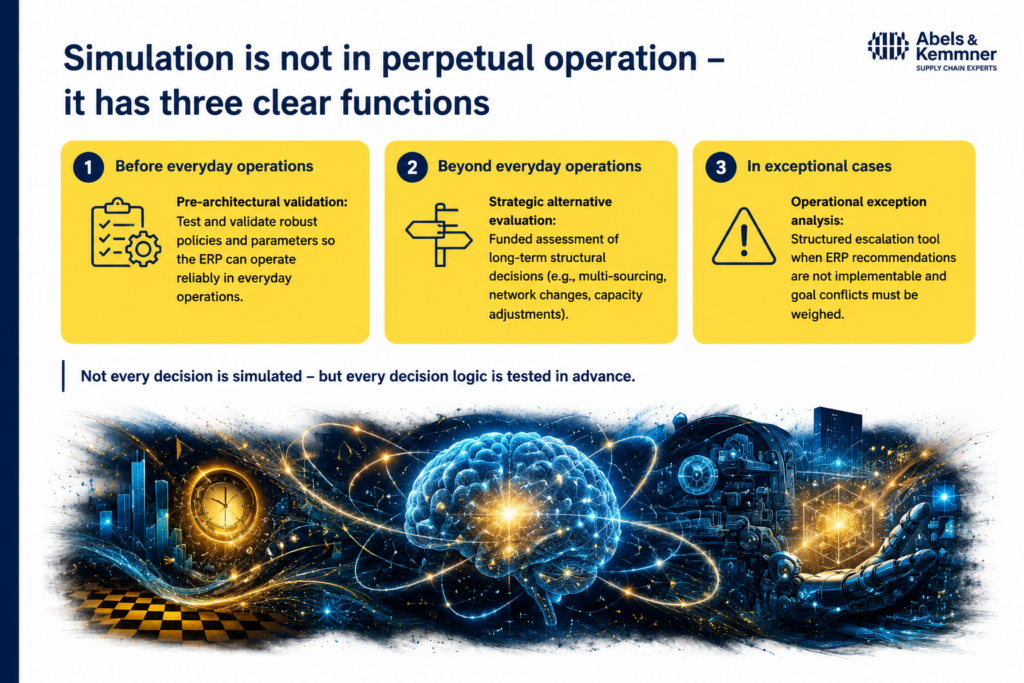
Rather, its role lies in three clearly defined functions.
- Firstly, simulation is used for architecture validation. Before day-to-day operations begin, policies and parameters are tested and validated under realistic conditions.
- Secondly, it supports the evaluation of strategic alternatives. These include structural decisions such as multi-sourcing, network changes, nearshoring, capacity adjustments or make-or-buy decisions.
- Thirdly, simulation can help in exceptional operational cases where ERP proposals are not feasible or where several conflicting objectives need to be weighed up against one another. The standard operational scenario, however, remains within the ERP system.
Not every decision is simulated. But every decision-making logic should have been tested beforehand.
The new architecture of planning
The planning of the future is not driven by a single technology, but by the interplay of several clearly defined levels.
The ERP system remains the operational execution system. Simulation serves as a validation environment. AI enhances analytical capabilities and transparency. Humans take charge of governance and normative decisions.
Autonomy does not arise from black-box systems or constant real-time optimisation. Autonomy arises from architecture: decisions follow defined rules, human intervention becomes the exception, results become reproducible, and decision-making logic remains transparent.
Robust automation is thus established at an earlier stage – through valid policies and resilient parameters.
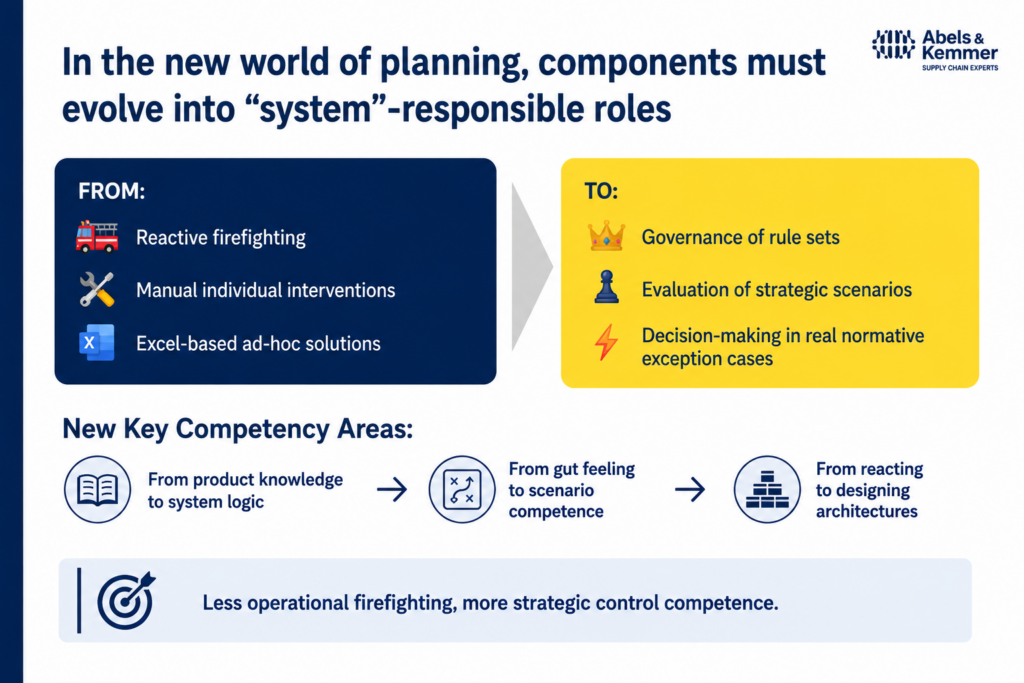
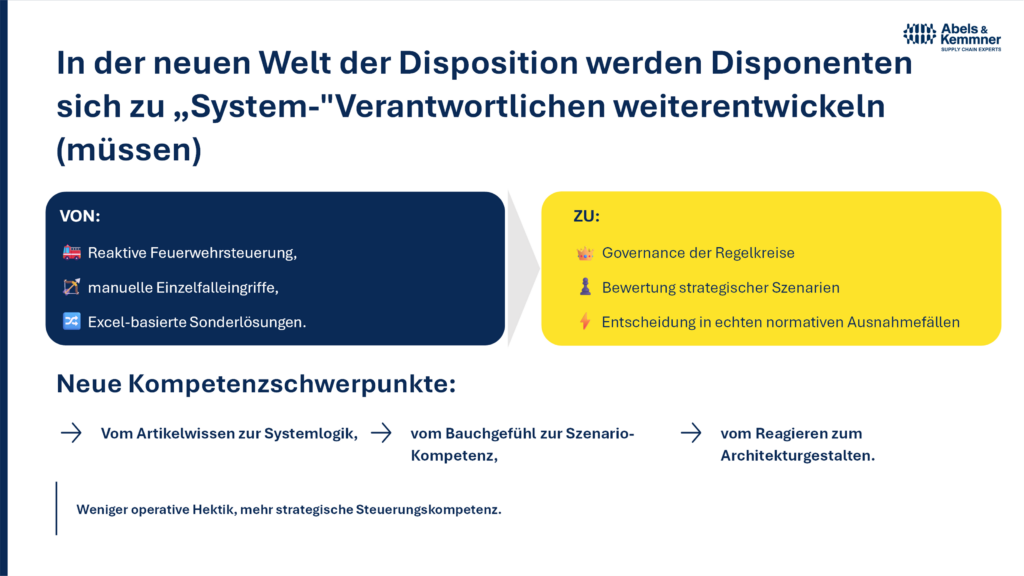
The role of the planning officer is undergoing a fundamental change
This development is also changing the role of planning officers. The role is not disappearing; it is evolving.
Manual ERP corrections, operational ‘firefighting’, Excel-based ad-hoc solutions and constant re-parameterisation are becoming less relevant. Conversely, the governance of regulatory frameworks, the evaluation of strategic scenarios, the interpretation of simulation results, the management of exceptional cases and the further development of decision-making architecture are gaining in importance.
The planner is thus evolving from someone who handles individual cases to a system manager. This requires new skills: analytical understanding, expertise in scenarios and simulations, process- and system-oriented thinking, governance skills, and an understanding of data and model logic.
It is not that fewer qualifications are needed, but rather different ones.
Conclusion: The future belongs to robust decision-making architectures
The supply chain management of the future will not be characterised by ever-faster operational interventions.
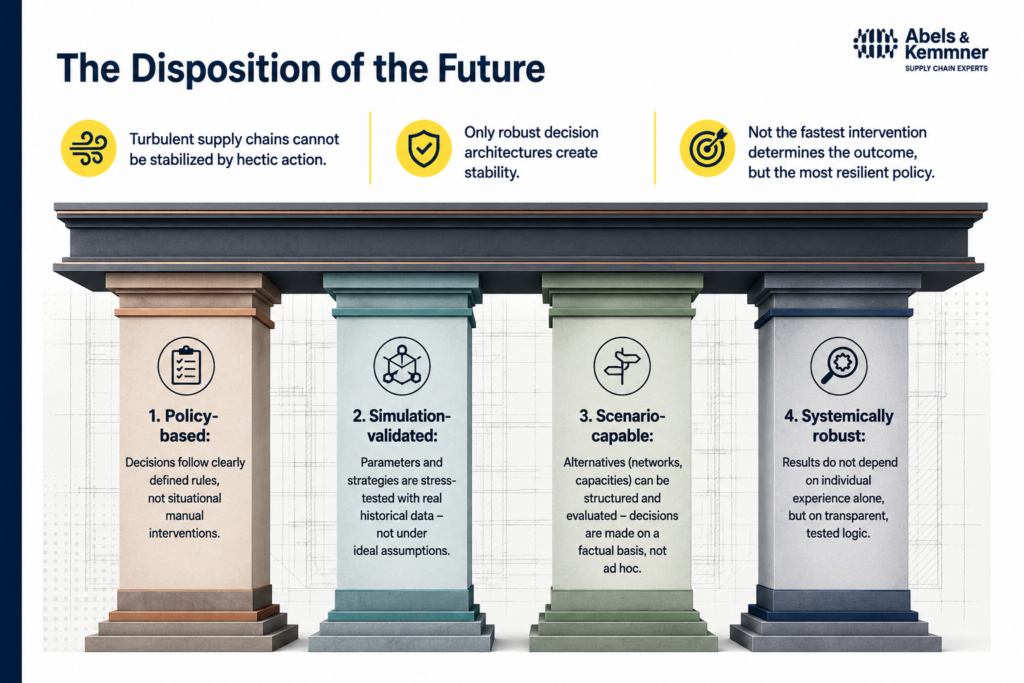
Turbulent supply chains cannot be stabilised by frantic activity. They require robust decision-making architectures.
The new supply chain management is policy-based, simulation-validated, scenario-capable and systemically robust. It uses AI not as a substitute for responsibility, but as analytical support. It combines operational execution with strategic governance.
The key insight is:
It is not the quickest intervention that determines future viability, but the most stable policy.
Companies that view their planning as a strategic architectural task will be able to manage turbulent supply chains in a significantly more robust, efficient and resilient manner in the long term.
FAQ – Frequently Asked Questions
What is meant by ‘disposition’ in the supply chain?
Materials planning involves the planning and control of material flows, stock levels and purchase orders. The aim is to ensure the availability of materials whilst optimising stock levels, costs and risks.
Why is planning becoming increasingly important today?
Volatile markets, global supply chains, increasing regulatory requirements and growing uncertainties make demand planning a crucial factor for success. It has a direct impact on delivery capability, capital tied up and competitiveness.
Why do traditional planning approaches reach their limits?
Many companies still rely on parameters that have evolved over time, manual interventions and Excel-based solutions. These approaches are often insufficient to manage the complexity and dynamism of today’s supply chains efficiently.
What does ‘robust planning’ mean?
A robust planning system remains stable even in the face of changes in demand, delivery delays, forecasting errors or market disruptions. Rather than relying on a ‘perfect plan’, it is based on reliable decision-making rules and resilient processes.
Which role does the bullwhip effect play?
The bullwhip effect describes the amplification of small fluctuations in demand along the supply chain. This leads to unnecessary stock, missing items and operational instability. A robust decision-making framework helps to reduce this effect.
How is artificial intelligence changing planning?
AI is particularly useful for forecasting, pattern recognition, risk analysis and monitoring data quality. It enhances analytical capabilities, but does not replace humans’ responsibility for strategic decision-making.
Can AI fully automate scheduling?
No. AI can help prepare decisions and identify risks at an early stage. However, assessing conflicting objectives – for example, between delivery capacity, stock levels and costs – remains a management and governance task.
What is a digital twin in the supply chain?
A digital twin is a virtual representation of the real-world supply chain. It enables various scenarios, parameters and strategies to be simulated and evaluated under realistic conditions before they are implemented.