
Geopolitical resilience: Is simply building up more reserves really enough?
The recently published European Business Survey, ‘Bridging the Gap between Geopolitics and Corporate Strategy’, by the Bertelsmann Stiftung, MERICS, Clingendael and FIIA, reveals a striking finding: many European companies have not yet systematically integrated geopolitical risks into their corporate strategy. The authors essentially refer to a significant gap between risk awareness and actual preparedness. Smaller companies in particular have so far taken significantly fewer measures than larger ones.
The risks are no longer abstract: Chinese export restrictions, US tariffs and import quotas, or potential disruptions to global supply chains have a direct impact on procurement and production. Nevertheless, for example, only a few of the companies surveyed have made concrete preparations for a potential crisis in Taiwan.
I find one of the authors’ conclusions particularly important:
Geopolitics must become a permanent planning parameter in business decision-making.
And resilience should not be viewed merely as an additional cost factor, but as an integral part of long-term competitiveness.
At this very point, however, I would go a step further.
I have been pointing out for some time now that European companies should systematically reduce their structural dependence on China as a sourcing market. One approach that is frequently discussed in this context is the build-up of additional safety stocks.
That may make sense. But it does not solve the actual problem.
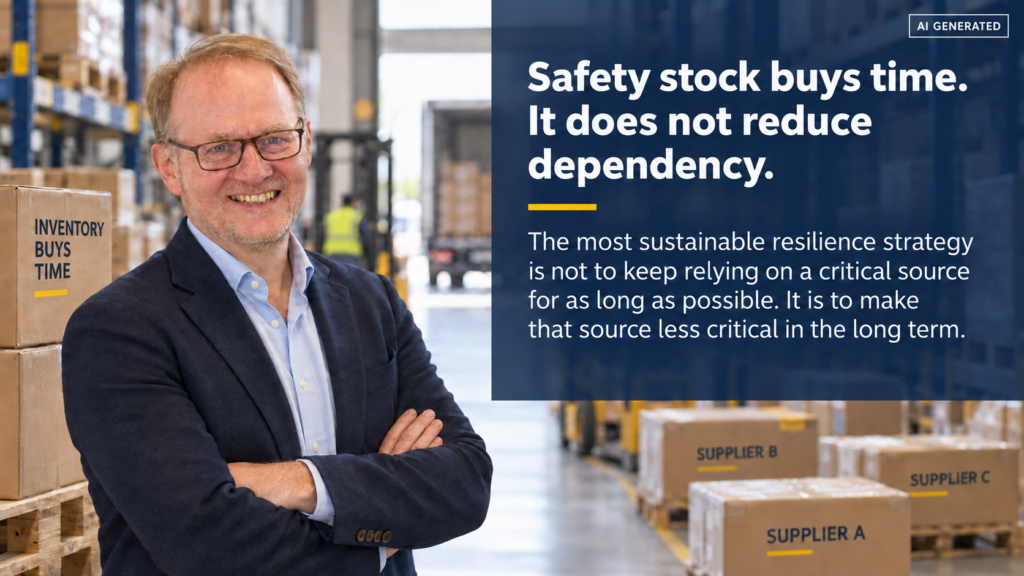
Safety stocks buy time. They do not alter any dependencies.
Let us assume a prolonged geopolitical disruption. A company that holds three or six months’ worth of additional stock can continue production for the time being, whilst competitors are already facing supply issues. However, this results in significant costs relating to capital tied up, storage and obsolescence.
And if, after a few months, virtually all companies are affected by the same structural disruption to supply, this temporary advantage disappears again.
My thesis is therefore:
The most sustainable resilience strategy is not to be able to carry on relying on a critical source for as long as possible. It is to make that source less critical in the long term.
Above all, this means:
Diversifying procurement markets, qualifying alternative suppliers and establishing resilient supply chains outside critical regions.
That sounds easier than it is. You cannot replace a supplier at the click of a mouse. Technical qualification, tools, processes, quality approvals, capacity and trust often take years to build up.
That is precisely why this task now forms part of strategic supply chain planning.
Inventories act as a buffer. Diversification changes the structure.
And it is precisely this structural change that is likely to be decisive if geopolitical risks do indeed become a permanent feature of our economic reality.
FAQ – Frequently Asked Questions
What are the disadvantages of maintaining high safety stock levels?
Geopolitical resilience refers to a company’s ability to maintain supply and production capacity despite geopolitical disruptions. This includes, amongst other things, diversified procurement markets, alternative suppliers, safety stocks and a systematic assessment of geopolitical risks as part of strategic supply chain planning.
Are higher safety stocks sufficient to hedge against geopolitical risks?
No. Higher safety stocks can temporarily bridge supply disruptions, but they do not eliminate structural dependence on individual suppliers or sourcing regions. In the event of prolonged disruptions, alternative sources of supply and diversified supply chains therefore become increasingly important.
Why is supply chain management important for corporate strategy?
Additional safety stocks tie up capital and incur storage costs. Furthermore, there is a risk of obsolescence, particularly in the case of technically complex or fast-moving products. Safety stocks should therefore be regarded as a buffer rather than as the sole resilience strategy.
How can companies reduce their reliance on China for procurement?
Companies can reduce their dependence on China by tapping into alternative procurement markets, qualifying additional suppliers and diversifying their sources of supply for critical components. This process often takes several years, as technical approvals, tooling, quality requirements and production capacity must all be taken into account.
What is the difference between safety stock and supply chain diversification?
A safety stock bridges a limited period without a new supply of materials. Supply chain diversification, on the other hand, changes the procurement structure by spreading dependencies across several suppliers, countries or regions. Both measures can complement one another, but they pursue different objectives.
How can companies incorporate geopolitical risks into their supply chain strategy?
Companies should first identify critical suppliers, materials and sourcing regions and assess their dependencies. Building on this, scenarios for potential supply disruptions can be developed and measures such as dual sourcing, alternative suppliers, regional diversification and targeted safety stocks can be prioritised.
What does dual sourcing mean in the context of geopolitical risks?
Dual sourcing means that a company can source a material or component from at least two suppliers. This helps to reduce dependence on a single supplier or location. It is crucial that alternative suppliers are technically qualified and can provide sufficient capacity when required.
Why is the qualification of alternative suppliers a long-term issue?
A new supplier often has to meet technical specifications, quality requirements and regulatory standards. In addition, new tools, production processes, audits and approvals may be required. Companies should therefore develop alternative sources of supply before an acute geopolitical crisis arises, where possible.