

Forecast Bias
Forecast bias describes a systematic deviation in forecasts. It indicates whether demand tends to be overestimated or underestimated over a longer period of time.
Forecast bias thus differs from a simple forecasting error. A forecasting error initially only shows the extent to which a forecast deviates from actual demand. Forecast bias also takes into account the direction of these deviations.
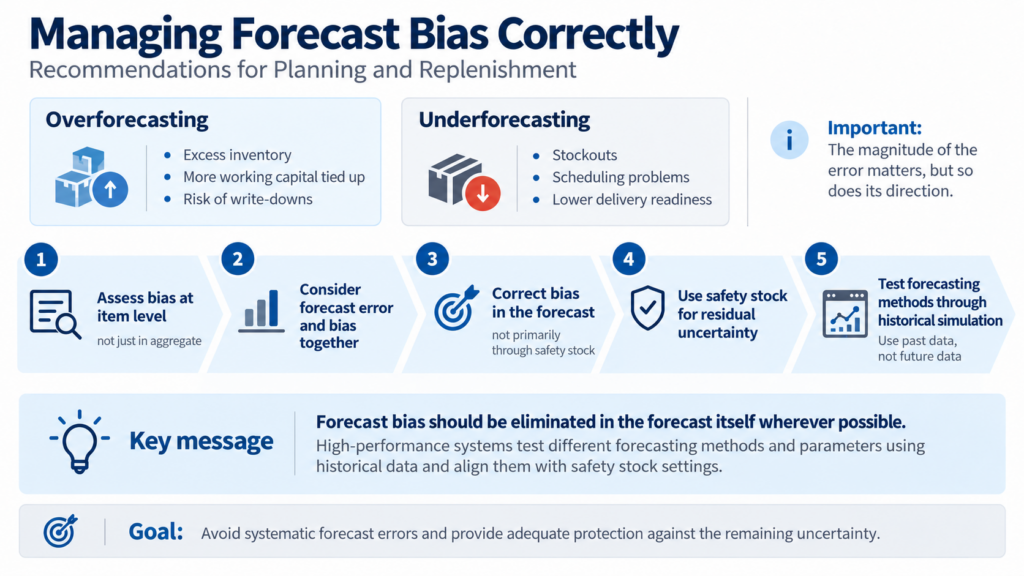
If demand is regularly overestimated, this constitutes a systematic over-forecast. If it is systematically underestimated, this constitutes an under-forecast. Depending on the calculation formula used, the sign of the bias may be defined differently. It is therefore usually clearer to refer to over-forecasts and under-forecasts.
A forecast may well have an acceptable average forecast error and still exhibit a problematic bias. A persistent one-sided deviation has a direct impact on planning and stock levels.
Systematic over-forecasting can, for example, lead to higher stock levels, additional working capital and depreciation risks. Systematic under-forecasting, on the other hand, increases the risk of missing items, delivery delays and insufficient availability.
Our tip:
Always consider forecast errors and forecast bias together. Forecast accuracy alone does not indicate whether your planning process is systematically biased in a particular direction.
As a general rule, assess forecast bias for planning decisions at the level of the individual item. Whilst an aggregated bias across product groups, sites or the entire product range may provide indications of systematic weaknesses in the forecasting process, it is of limited relevance for specific planning decisions, as over- and under-forecasts for different items can cancel each other out.
High-performance forecasting systems support this process by reviewing different forecasting methods and their parameter settings for each item and aligning them with the safety stock policy. It is not possible to determine which method is actually suitable for a particular item simply by looking into the future.
For this reason, alternative forecasting methods must be tested using simulations based on historical data: the system determines what the forecast would have been at an earlier point in time and compares it with the actual demand that is now known. In this way, it is possible to select methods and settings that would have delivered the most robust planning results possible under real historical conditions.
Even modern forecasting methods cannot, therefore, predict the future. However, they can identify systematic forecasting errors and, through the appropriate selection and parameterisation of forecasting methods, minimise them as far as possible.