
Forecast Value Added (FVA)
Forecast Value Added (FVA) describes a systematic method of measuring whether individual steps within a forecasting process actually improve or worsen forecast quality.
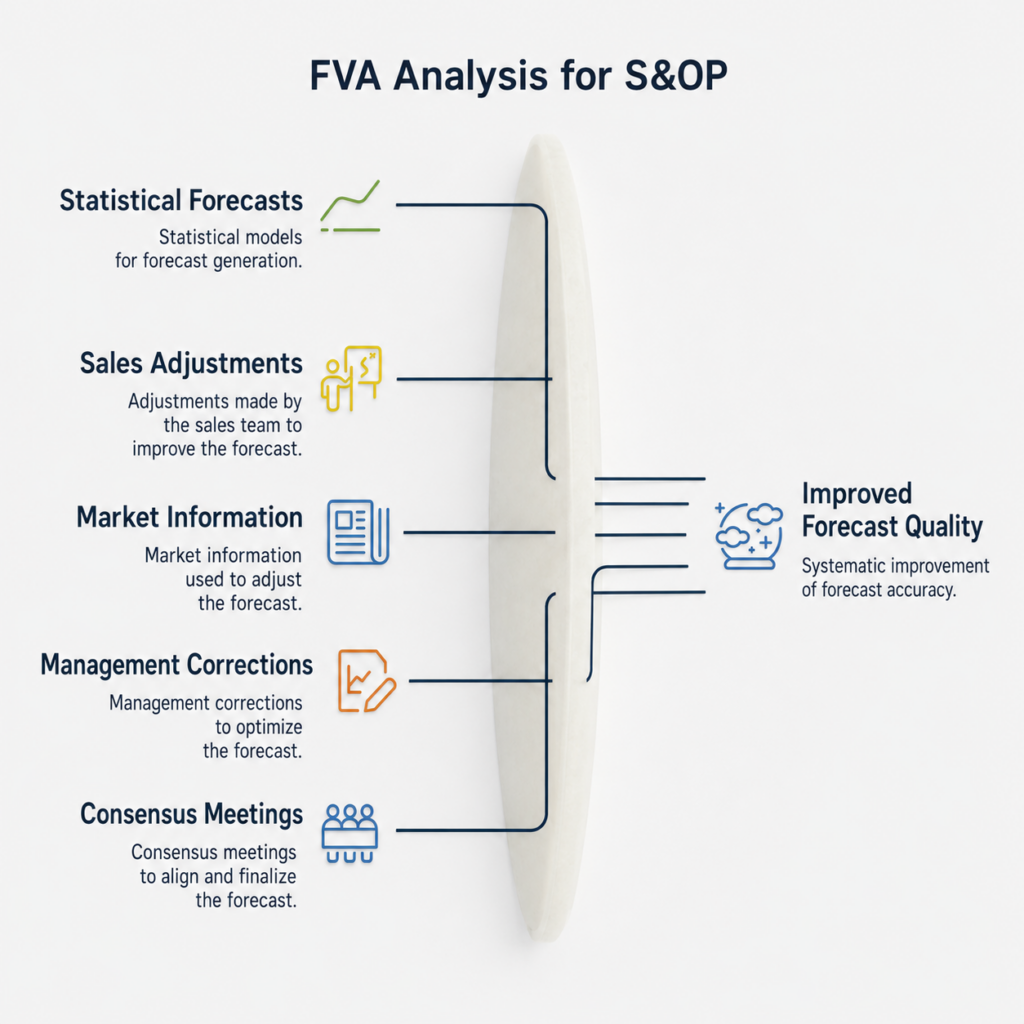
This involves analysing the contribution made to the final forecast by, for example:
- statistical forecasts
- sales adjustments
- market information
- management adjustments
- consensus rounds in S&OP
The basic idea is simple: not every manual adjustment improves a forecast.
Measuring FVA is particularly important when forecasts are discussed and adjusted over several iterations. This often involves considerable effort without any measurable improvement in forecast quality.
Forecast Value Added provides the necessary transparency:
- Which planning steps create real added value
- Where systematic deterioration may even occur
- Which meetings or coordination sessions are actually effective
This makes FVA an important tool for the further development of S&OP processes. Particularly in established S&OP organisations, this often leads to the surprising realisation that more coordination does not automatically mean better planning.
The original academic approach of Forecast Value Added primarily assesses whether individual process steps improve or worsen the statistical quality of the forecast. Typically, metrics such as Forecast Accuracy, MAPE or Bias are used for this purpose.
From a supply chain perspective, however, this analysis often falls short.
Greater forecast accuracy is not an end in itself. What matters far more is whether planning improves operational and financial performance, for example through:
- lower stock levels
- greater delivery readiness
- less obsolescence
- more stable production schedules
- fewer special shipments
- less tension in the supply chain
- lower overall costs
This is often where the real challenge lies in practice: a forecast can become statistically ‘better’ without the operational supply chain improving — in some cases, the opposite may even be true.
For example:
- aggressive smoothing may improve the MAPE, but at the same time cause stock-outs during demand peaks,
- a deliberately higher sales forecast may formally reduce forecast quality, but at the same time prevent delivery failures,
- or higher forecast accuracy may lead to more frequent plan changes and thus to greater instability in production and procurement.
Forecast Value Added should therefore not be viewed in isolation as a statistical metric. Far more important is the question of whether a planning step actually contributes to improving overall supply chain performance.
Our tip:
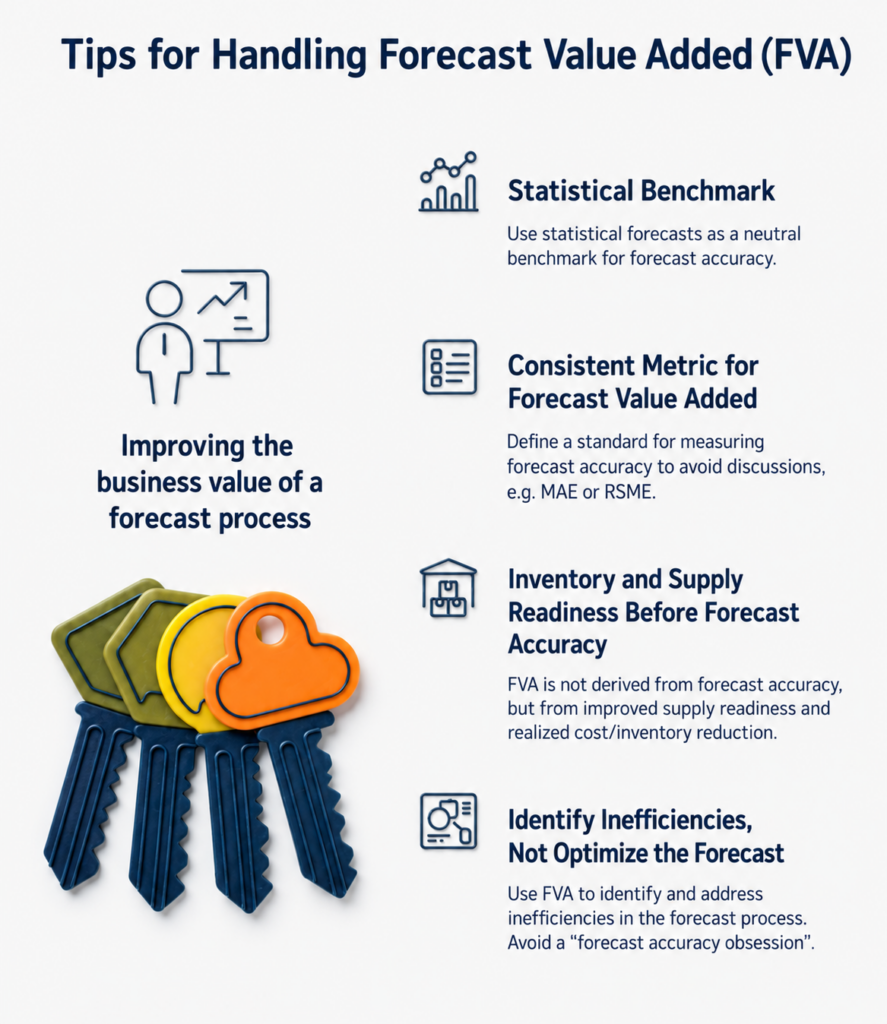
Use the statistical forecast as a benchmark
Measuring FVA only works if you start from a neutral baseline. The statistical forecast serves as the benchmark against which all subsequent adjustments are measured.
Measure forecast errors consistently
Different metrics can quickly lead to debate. You should therefore define a clear standard for measuring forecast quality. For this, you should not use the MAPE metric, which is popular in practice, but rather MAE or RMSE. For a better understanding, we refer you to the insightful publications by Nikolaus Vandeput.
Pay attention not only to accuracy, but also to availability and stock levels
Some companies develop highly complex metrics to measure forecast quality. This can not only increase complexity, but eventually leads to a situation where nobody really understands how the value is derived.
More importantly: the actual purpose of a good forecast is not to achieve the highest possible forecast accuracy. The aim is rather to ensure the desired delivery readiness with as little stock and as low costs as possible.
For this aim, it is not only forecast accuracy that plays a role, but also the quality of safety stock sizing. High forecast quality combined with an unsuitable safety stock can lead to lower delivery readiness and higher stock levels than a slightly poorer forecast with appropriately sized safety stock.
Use FVA primarily to identify inefficiencies in the forecasting process
In our view, Forecast Value Added should not be understood as either a disciplinary tool or an isolated target metric for continuous optimisation.
In practice, the point is often quickly reached where the effort required to further improve forecast accuracy is no longer in reasonable proportion to the actual benefit.
In our experience, it is counterproductive to use Forecast Value Added or forecast accuracy as a tool for monitoring individual staff members. This regularly results in both the acceptance of the metric and the quality of the entire planning process suffering.