
Demand Sensing
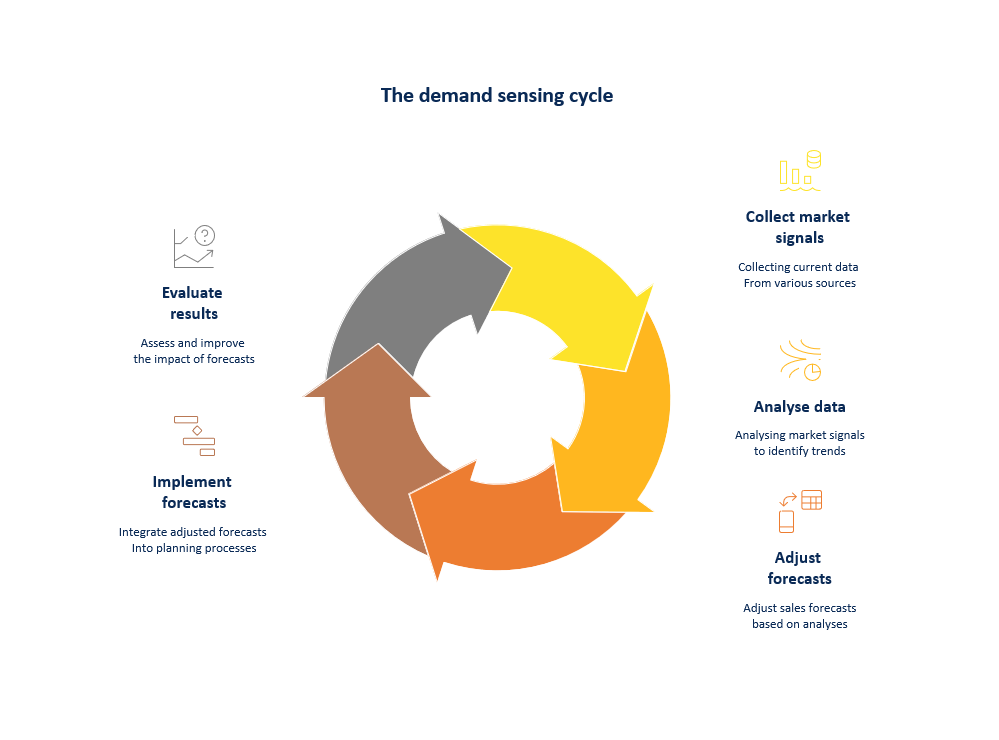
Demand sensing refers to the short-term, data-based adjustment of sales forecasts based on very recent market signals. While traditional forecasting methods such as exponential smoothing or ARIMA are primarily based on historical time series, demand sensing also integrates daily updated information – such as order intake, POS data, sales figures, promotional information, and market or weather data.
The aim is to identify changes in demand much earlier and to dynamically correct forecasts for the coming days or weeks. The focus is therefore clearly on the short-term planning horizon.
In volatile markets in particular, the past quickly loses its significance. Short product life cycles, strongly promotion-driven sales patterns, or seasonal effects increase the risk of systematic forecasting errors. Used correctly, demand sensing can reduce shortages, avoid overstocking, stabilise service levels, and increase the response speed of the supply chain. However, this requires a reliable database and seamless integration into existing planning processes.
Our tip:
Demand sensing is not a substitute for sound sales planning, but rather a corrective mechanism. Without a stable baseline forecast, existing errors will simply be amplified more quickly. Companies should therefore first ensure that their forecasting process is methodologically sound.
In addition, not every short-term fluctuation is a relevant signal. Overreactions create operational unrest in procurement, production and logistics. It is crucial to clearly define which impulses are actually relevant to planning and to what extent they should be taken into account.
It is equally important to consider the replenishment time. Demand sensing only has an effect where the supply chain can actually respond. In the case of long procurement or production lead times, the effort involved in demand sensing is usually disproportionate to the benefits.
Finally, systematic performance measurement is recommended, typically via forecast accuracy or forecast value added. This is the only way to assess whether demand sensing actually contributes to improving inventory and service levels.
When implemented correctly, demand sensing increases the short-term controllability of the supply chain. Without clear processes and discipline in forecasting, however, it leads to operational chaos. It is not only the tool itself that is crucial, but also its integration into a consistent planning process.