

Who Owns the Safety Stock? Who Sets It and Who Is Allowed to Use It?
Sales, Materials Planning, Production, Purchasing, and Spare Parts Management often view safety stock from different perspectives. This leads to manual adjustments, hidden reserves, and disputes over who is allowed to access which inventory when shortages occur. Such conflicts cannot be resolved by adding another inventory column to the ERP system. Companies need clear responsibilities for the purpose of the buffer, its calculation, approval, and use. Only then can safety stock protect delivery performance without becoming a general reserve for unresolved problems.
The Question of Ownership Misses the Point
Safety Stock Is Usually a Threshold, Not a Physically Segregated Reserve
Who owns the safety stock? At first glance, the question seems reasonable. From a sales perspective, committed customer delivery dates need to be protected. In production, missing materials can bring an order to a halt. Spare parts management points to urgent service requirements. Purchasing, in turn, sees the available buffer as additional time to compensate for delayed deliveries. Each department is pursuing a legitimate objective. Taken together, however, these different perspectives often result in an unclear and costly inventory management approach.
The idea of a separate pile of inventory labeled “Safety Stock” is misleading. In most cases, safety stock represents an inventory planning parameter or a stock level threshold. The same physical components can be used to fulfill a customer order, meet production requirements, or supply spare parts. Only an explicit reservation, allocation, or stock restriction assigns specific quantities to a particular purpose.
This distinction has practical implications. Statistically calculated safety stock and physically protected inventory are two different inventory control mechanisms. Statistical parameters influence replenishment planning, while a protected reserve restricts inventory availability for certain requirements. Companies that treat both concepts as the same cannot accurately explain either the capital tied up in inventory or the specific purpose of the buffer.
The A&K article “In a Nutshell: Safety Stock Dynamics” describes safety stock as a dynamic buffer designed to ensure delivery reliability for external customers or internal consumers, such as production. This clearly defines its purpose. However, it does not establish ownership or exclusive rights to use the inventory.
A Buffer That Is Never Used Does Not Fulfill Its Purpose
Statistically calculated safety stock is designed to absorb fluctuations. When the risk it is intended to cover materializes, available inventory falls into the safety stock buffer. Occasionally, the buffer may even be completely depleted. This does not necessarily indicate poor planning, provided that the frequency and economic consequences are consistent with the targeted service level.
The widespread belief that safety stock must never be used changes its function. Instead of serving as a risk buffer, it becomes a permanently restricted minimum inventory level. Although this quantity physically exists, operational planning is not allowed to use it. This ties up capital and only provides effective protection if clear rules govern its release in the event of a disruption.
Falling below the safety stock level is therefore primarily a signal that the risk the parameter was designed to cover has materialized. Whether additional prioritization, escalation, or the release of reserved inventory is required depends on the type of demand. The discussion thus shifts toward aligning the buffer with a specific risk and a defined service level target.
Identify the Risk First, Then Choose the Right Buffer
Quantity Uncertainty Requires a Different Approach Than Timing Uncertainty
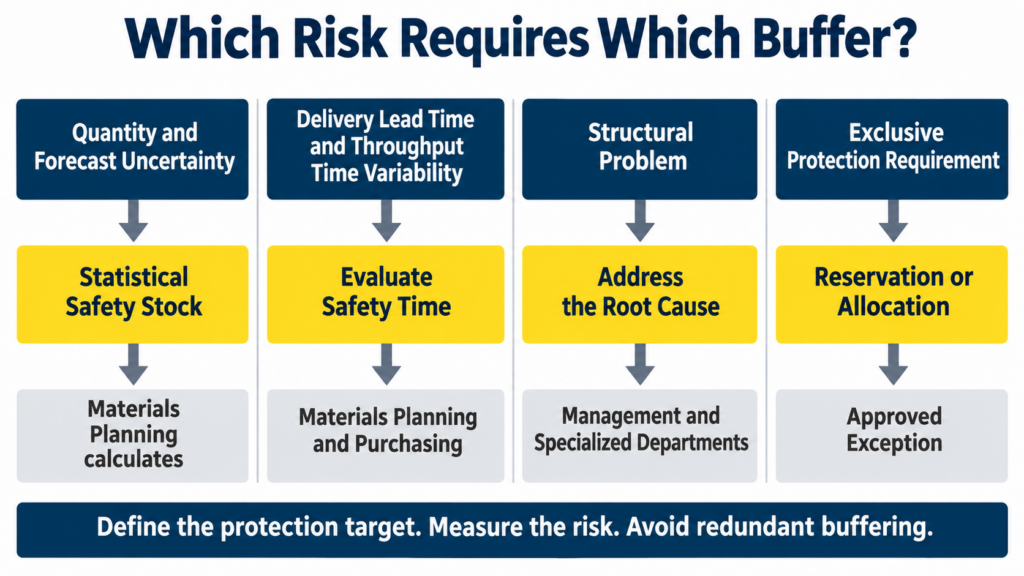
Selecting the right buffer starts with a thorough assessment. Demand fluctuations and forecast deviations affect the quantity required during the replenishment lead time. Variations in supplier lead times or production throughput times, on the other hand, affect when a planned quantity becomes available. Both effects can occur simultaneously, but they should remain clearly distinguishable in the planning process.
Safety stock is fundamentally a quantity buffer. Statistical calculations combine the target service level, replenishment lead time, and observed uncertainty. SAP documentation on safety stock calculations illustrates this approach for a specific system configuration using a safety factor, replenishment lead time, and forecast error. The formula is not equally suitable for every demand pattern. However, it demonstrates why an arbitrarily estimated safety stock adjustment by the sales department is no reliable substitute for statistically determined planning parameters.
Safety time addresses a different aspect of uncertainty. It brings the planned receipt date forward relative to the actual requirement date. The A&K article “In a Nutshell: Safety Time” explains how this creates a time buffer to compensate for fluctuating delivery lead times. If a delivery arrives late, this time advantage is gradually consumed. If it arrives earlier, physical inventory is held until the actual requirement date.
Safety Time Can Reduce Inventory, but Not Necessarily
When uncertainty primarily concerns delivery timing, safety time is often the first parameter worth examining. It links earlier material availability to a specific requirement, whereas procurement safety stock establishes an additional quantity. Under suitable conditions, a time buffer can therefore tie up less capital in inventory.
However, this does not mean that safety time is always the better option. In their study “Safety Stock versus Safety Time in MRP Controlled Production Systems,” Buzacott and Shanthikumar demonstrate that the suitability of safety time depends, among other factors, on how reliably future requirements are known within the lead time. If quantities and delivery dates change frequently, a quantity buffer may offer greater flexibility. Lot sizes, capacity constraints, and the relationship between inventory holding costs and shortage costs also influence the decision. Molinder therefore examines the joint optimization of lot sizes, safety stocks, and safety times rather than generally favoring one approach over another.
For practical application, this leads to a clear sequence of considerations:
-Demand and forecast uncertainty should primarily be addressed through statistically calculated quantity buffers.
-Delivery date and production lead time variability should primarily be evaluated using safety time.
-Combined risks may require several buffering mechanisms, whose effects must be assessed together.
-Persistent process or capacity problems require corrective action at the source rather than continuously increasing buffer levels.
Structural Problems Should Not Be Compensated for by Ever-Larger Buffers
A supplier that consistently delivers later than the lead time recorded in the ERP system is not causing random variability. In this case, either the planned delivery lead time is incorrect or the supplier is systematically failing to meet the agreed performance standards. Additional safety stock merely conceals the discrepancy. The same applies to insufficient production capacity, recurring quality issues, or unreliable material release processes.
Such underlying causes require corrections to master data, supplier development measures, capacity decisions, or alternative sources of supply. A temporary buffer may be necessary while these issues are being resolved, but it cannot replace corrective action.
For each risk, the primary buffering mechanism should therefore be documented. If the same delivery lead time uncertainty is simultaneously accounted for through safety time, safety stock, and a blanket adjustment by the sales department, the company effectively pays multiple times to protect against the same risk. Only by clearly distinguishing between quantity uncertainty, timing uncertainty, and structural problems can responsibilities be assigned unambiguously.
Responsibility for Service Level Targets and Planning Parameters Must Be Separated
Management and Sales Define the Service Commitment, Not the Quantity in the Material Master Data
The target service level is a business objective. A higher target may require more inventory, earlier procurement, or additional capacity. A lower target reduces the resources needed to safeguard delivery performance but increases the risk of shortages. This trade-off should not be left to a single operational department.
Executive management, or a cross-functional body appointed by it, defines the hierarchy of objectives and the company’s risk tolerance. Sales provides essential information for this process: How do customer groups differ in their requirements? What response times have been promised? Which promotional campaigns, product launches, or contractual consequences need to be considered? This information defines the service commitment, but it does not directly determine the quantity of safety stock required.
The article “Inventory Management Is a Management Responsibility” addresses precisely this conflict of objectives at the executive level. Sales, Purchasing, Production, and Supply Chain Management each act rationally from their own perspectives. Without a shared hierarchy of objectives, individual departments accumulate additional safety buffers. The result is excessive inventory whose actual contribution to delivery performance remains difficult to assess.
Materials Planning Translates Targets and Measured Data into Planning Parameters
At plant level, operational responsibility for calculating and maintaining safety stock parameters should lie with Materials Planning or a clearly designated Supply Chain Planning function. This is where consumption data, forecast errors, replenishment lead times, lot sizes, and inventory effects come together. Materials Planning translates the defined service objectives into planning parameters using a standardized methodology and monitors their effectiveness.
However, this does not make Materials Planning solely responsible for the underlying risks. It depends on reliable input from other departments. Purchasing provides agreed and actual supplier lead times, along with information about supply disruptions. Production contributes data on scrap rates, production lead time deviations, capacity constraints, and sequencing rules. Spare Parts Management defines criticality levels and committed response times. Sales provides market and customer requirements. Each department is responsible for the quality of the data it contributes.
Statistical calculations do not automatically produce the correct answer. Items with intermittent demand, short product life cycles, or limited historical observations require different methods than regularly consumed standard items. Simulation can help compare the effects of alternative planning parameters on inventory levels, shortages, and service levels. The A&K article on balancing service levels and inventory using a Digital Twin demonstrates the benefits of evaluating these effects through simulation.
Clear Responsibilities Require Traceable Data and a Defined Approval Process
A planning parameter can only be managed effectively if its origin and underlying assumptions are transparent. At a minimum, the documentation should include the purpose of the buffer, the source of risk, the target service level, the calculation method, the data period, the date of the last change, and the person or function responsible for maintaining the parameter. Manual adjustments should additionally record the approver, the justification, and an expiration date.
This transparency prevents a common scenario: A safety stock value is increased during a critical situation, never reduced afterward, and continues to be treated as supposedly statistically calculated safety stock years later. Nobody remembers the original assumptions, yet every attempt to reduce the value meets resistance. A traceable parameter history makes it possible to distinguish between the statistically calculated portion and any deliberately added buffer.
The organizational recommendation is therefore clear: Management is responsible for service objectives and risk tolerance. Materials Planning is responsible for the methodology, calculation, and maintenance of planning parameters. The relevant departments are responsible for requirements, knowledge of underlying causes, and data quality. A clearly designated authority approves exceptions.
This responsibility model establishes the standard operating framework. Its effectiveness becomes evident when special requests arise.
When Additional Sales-Driven Safety Stock May Be Justified
Special requirements from Sales are not necessarily unjustified. A product launch, a temporary promotional campaign, or a contractually agreed response time may require additional protection against shortages. Companies may also deliberately tie up more capital in inventory for strategic customers if the economic consequences of a shortage justify the additional investment.
However, before increasing safety stock, the appropriate planning and control mechanism must be selected. Expected promotional demand belongs in demand planning. Different customer service commitments can be reflected through service level classes. Scarce materials intended for specific customers require allocation rules. Quantities that must be exclusively protected require reservations or stock restrictions. Only when these mechanisms cannot adequately address the requirement should a manual safety stock adjustment be considered.
Sales therefore defines the reason, duration, and business priority of the request. Materials Planning assesses how the proposed adjustment interacts with existing planning parameters. Approval is granted by the authority responsible for balancing customer service, capital tied up in inventory, and associated risks. This allows justified exceptions without creating a second, invisible calculation system.
Manual Adjustments Must Be Recorded Separately Rather Than Silently Added
An approved manual adjustment must not overwrite the statistically calculated baseline value. Both values must remain separately visible. Otherwise, it becomes impossible to review the original reason for the adjustment or selectively remove the exception later.
At a minimum, the following information should be mandatory for any manual override:
-Specific demand to be protected or identified risk
-Additional quantity or inventory coverage
-Start date and automatic expiration date
-Responsible requester and approver
-Expected impact on costs and delivery performance
-Scheduled date for reviewing effectiveness
Before approval, a check for double counting must be performed. Is the demand already included in the forecast? Has safety time already been established to cover the same delivery uncertainty? Is there an existing customer-specific reservation? Is the additional buffer already reflected in a generally increased target service level? Every affirmative answer requires either a correction or an explicit justification for using multiple buffering mechanisms.
Physically Protected Inventory Requires a Different Decision
A reserve designated for a specific customer, an urgent order, or a critical spare part serves a more narrowly defined purpose than statistically calculated safety stock. It is deliberately not intended to be available for every regular requirement. It therefore needs its own designation, clearly defined access rules, and an identifiable person or function responsible for it.
This distinction goes beyond terminology. A statistical buffer can be incorporated into standard inventory planning and availability calculations. A physical or system-based reservation deliberately excludes certain requirements from accessing the reserved quantity. When these concepts are mixed, the ERP system may show available inventory, yet it remains unclear why an order cannot be confirmed.
This also answers the question regarding Sales: The Sales department may submit justified requirements and contribute to defining service level classes. However, it should not independently increase safety stock quantities in the material master data. If a specific quantity needs to be exclusively protected, an approved reservation decision is required.
Access Rights Are Governed by Prioritization Rules
Inventory Consumption, Falling Below Safety Stock Levels, and Special Authorization Are Not the Same
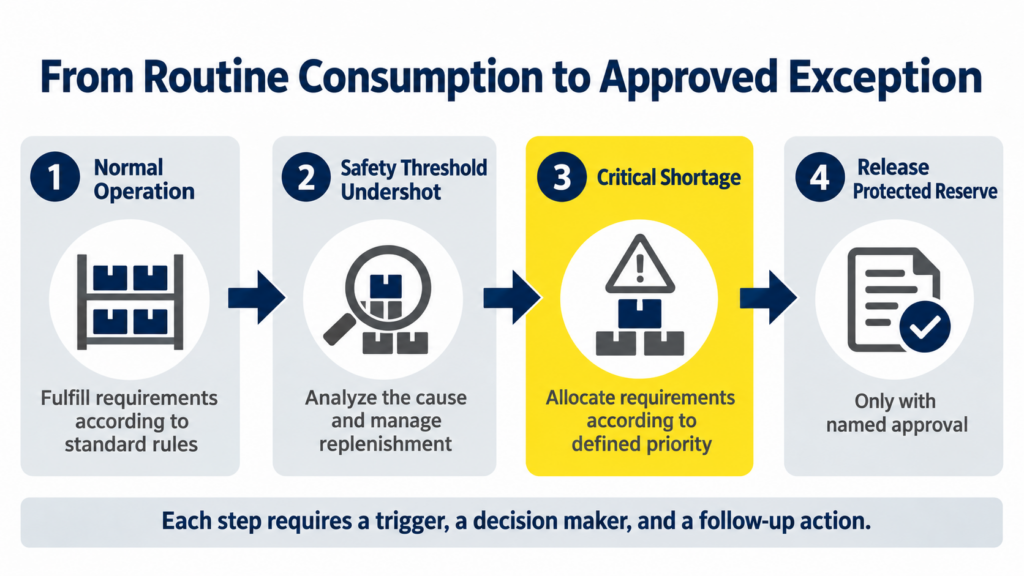
Safety stock generally does not consist of specific serial numbers or pallets. Regular orders consume available inventory according to the established planning and availability rules. If inventory falls below the safety stock threshold, this is initially a normal consequence of the buffer fulfilling its purpose. Materials Planning identifies the need for action and plans replenishment.
Special authorization is only required when a demand must be fulfilled outside the agreed order of priority or when explicitly protected inventory needs to be released. This distinction is essential for effective governance. Without it, every drop below the safety stock threshold is mistakenly treated as a violation of the rules. As a result, employees may restrict access to the buffer as a precaution or create additional hidden inventory reserves.
Purchasing does not directly “use” safety stock either. When a delivery fails to arrive, planned inventory receipts are missing. Customer or production requirements reduce existing inventory and thereby consume the buffer. Purchasing is responsible for monitoring delivery dates, investigating causes, and implementing corrective measures with suppliers. However, this does not grant Purchasing any independent right to withdraw inventory.
Production, Spare Parts Management, and Sales Need a Common Order of Priority
During a shortage, customer orders, production orders, and spare parts requirements often compete for the same inventory. Making decisions based on which department demands attention most urgently leads to constantly changing priorities and unreliable delivery commitments. Companies therefore need a predefined order of priority or clear business rules.
Suitable criteria include the risk of production downtime, contractual consequences, customer classification, substitutability, available alternative inventory, replenishment lead time, and the economic impact of failing to deliver. These criteria must reflect the company’s business model. An inexpensive spare part may deserve the highest priority if its absence causes a customer’s equipment to shut down. Conversely, an expensive production order may receive lower priority if the required material can be substituted quickly or the delivery date can be postponed without significant consequences.
Prioritization rules should not be developed only when a shortage occurs. Sales, Production, Spare Parts Management, Purchasing, and Supply Chain Management should establish them jointly, with executive management making decisions where economic objectives conflict. Operational teams then apply these rules to specific situations. If the rules do not provide a clear answer, a predefined escalation process must be followed.
The ERP System Implements the Decision but Does Not Make It
Checking rules, availability checks, allocation mechanisms, order priorities, and restricted inventory can technically support the agreed order of priority. SAP documentation on the scope of availability checks illustrates, for example, that the inclusion of safety stock can be controlled through the checking group and checking rule. However, the ERP system does not determine which department is morally or economically “right.” It implements business rules that have already been established.
An older SAP scenario for spare parts management also illustrates this principle: Inventory can be protected so that regular orders cannot consume it, while specifically defined urgent orders are allowed access (SAP Safety Stock for Spare Parts Management). This is not a universally applicable organizational model for every ERP system, but it provides a useful example of explicitly defined access classes.
A practical escalation framework distinguishes between four situations. Above the safety stock threshold, requirements are fulfilled according to standard rules. When inventory falls below the threshold, Materials Planning investigates the cause and initiates replenishment. Once a critical inventory threshold is reached, predefined demand prioritization rules take effect. A protected reserve is released only after approval by the designated authority. Each stage therefore has a defined trigger, a responsible decision-maker, and a documented follow-up action.
Four Decisions, Four Areas of Responsibility
The question posed in the title can only be answered in day-to-day operations if four decisions are clearly distinguished. The service objective defines the desired delivery performance for each segment, while the calculation translates this objective and observed uncertainty into a planning parameter. Temporary special requirements are handled through an exception approval process. In the event of an actual shortage, demand prioritization rules apply.
Each decision requires one clearly accountable authority. A&K recommends the following allocation of responsibilities:
-Executive Management or an Authorized Steering Committee: Service objectives, risk tolerance, and economic trade-offs.
-Materials Planning or Supply Chain Planning: Methodology, calculation, system maintenance, and performance evaluation.
-Sales, Purchasing, Production, and Spare Parts Management: Functional requirements, relevant events, knowledge of underlying causes, and data quality.
-Designated Approval Authority: Manual overrides, release of protected reserves, and decisions outside the established prioritization rules.
The specific organizational structure may be centralized, decentralized, or hybrid. In a corporate group, for example, a central Supply Chain function may define methodologies and thresholds, while plant-level Materials Planning maintains the parameters. What matters is that accountability does not become fragmented across departments and that local adjustments follow a common set of rules.
Planning Parameters and Exceptions Require a Defined Lifecycle
Safety stock requirements change with demand, forecast accuracy, lead times, and business requirements. A one-time calculation is therefore insufficient. Planning parameters must be reviewed at regular intervals and whenever significant structural changes are identified. The A&K article on plan-driven materials planning places the continuous maintenance of planning parameters within a rule-based planning framework.
Manual overrides require an even stricter lifecycle. Every exception begins with a documented justification and expires automatically. If an extension is required, the requester must demonstrate that the risk still exists and provide evidence of the adjustment’s effectiveness. This makes the removal of temporary adjustments the standard procedure rather than a politically sensitive individual decision.
Performance can be monitored using a limited number of key indicators: achieved service level, average inventory levels and inventory value, frequency and duration of safety stock threshold violations, number of expediting measures, age of manual adjustments, and instances of overlapping risk coverage.
No single indicator is sufficient. A high service level may be achieved at the expense of excessive inventory, while low inventory levels may come at the cost of increased shortages.
The Answer to the Question in the Title
Safety stock serves a clearly defined purpose: protecting against specific risks to delivery performance. Management is responsible for defining the service commitment and acceptable level of uncertainty. Materials Planning is responsible for calculating and maintaining the planning parameters. Requirements and data are provided by the relevant departments. Manual adjustments or protected reserves require separate, time-limited approval.
Access to safety stock is not based on departmental ownership either. Regular requirements consume inventory according to agreed planning rules. In the event of a shortage, predefined prioritization rules determine which requirements take precedence. Releasing an explicitly protected reserve remains a documented exception.
This restores safety stock to its intended role: a transparent and measurable risk buffer that safeguards delivery performance. It cannot replace efforts to address underlying problems in Purchasing and Production, nor can it substitute for clear decisions regarding customer and demand priorities. It is precisely this separation of responsibilities that enables companies to manage inventory, costs, and delivery performance in a coordinated and effective manner.
FAQ – Frequently Asked Questions
Who Should Determine Safety Stock Levels?
Management defines the target service level and the company’s tolerance for economic risk. Materials Planning or a central Supply Chain Planning function uses these objectives to calculate safety stock levels, maintains the corresponding parameters in the ERP system, and monitors their effectiveness. The relevant departments provide requirements and risk-related data. This ensures a clear separation between strategic service level decisions and statistical parameter calculations.
Can the Sales Department Request Additional Safety Stock?
The Sales department can and should communicate specific market or customer requirements. A manual safety stock adjustment may be justified if its purpose, quantity, cost impact, approver, and expiration date are documented. Before making such an adjustment, it should be assessed whether demand forecasting, service level classes, allocation rules, or reservations would address the requirement more appropriately. Unauthorized changes to the statistically calculated baseline value should not be permitted.
Can Production Use Safety Stock?
Production requirements consume available inventory according to established planning and prioritization rules. Falling below the safety stock threshold may be part of the buffer’s intended function. Special authorization is only required when explicitly reserved inventory needs to be released or the agreed order of demand priorities is overridden.
When Is Safety Time Better Than Safety Stock?
Safety time is particularly worth considering when delivery or production lead times fluctuate, while future demand quantities within the lead time are reliably known. It allows planned receipts to be brought forward based on specific requirements, potentially eliminating the need for a permanent quantity buffer. However, safety stock may be more suitable when demand fluctuates, lot sizes are large, or capacity constraints exist. The effectiveness of both approaches should be compared for each item group.
