

Organising supply chain planning: centralised, decentralised or hybrid?
Across more than 300 projects, we have observed a pattern that recurs so persistently that it hardly comes as a surprise any more. A company opts for decentralised planning because it wants flexibility. The regional teams are meant to stay close to the market, react quickly and take local circumstances into account. That sounds sensible. A few years later, a sober assessment of the current situation reveals that stock levels are 10 to 25 per cent higher than those of similarly structured competitors. Responsibilities are unclear, planning parameters are inconsistent, and the APS software that has just been introduced is delivering only a fraction of its potential benefits.
The choice of planning organisation is not a matter of style, nor is it a question of structural preference for organisational chart enthusiasts. It is a decision with measurable consequences for stock costs, delivery reliability and the effectiveness of your IT investments. This guide explains the three basic models, their actual costs and strengths, as well as five criteria to help you make the right choice for your business.
Why the organisational structure of supply chain planning is now crucial
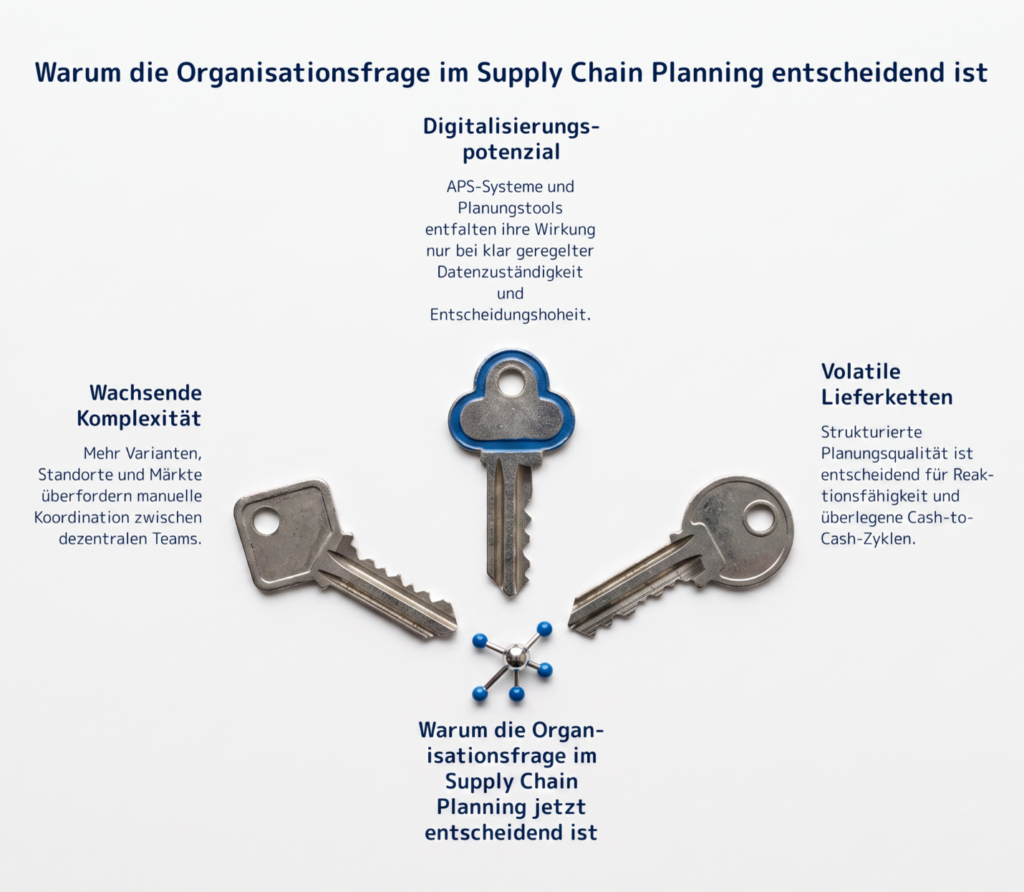
The organisational structure of supply chain planning determines who makes forecasting decisions, how quickly the organisation responds to market changes, and whether IT investments deliver their full potential. Many companies have never consciously addressed this issue. The structure has evolved organically rather than being deliberately designed.
For a long time, the consequences of this were manageable. Supply chains were more stable, product ranges narrower, and systems simpler. Three developments have now changed the situation.
Growing complexity demands clear lines of responsibility
Product portfolios are expanding. More variants, more sites and more markets mean a level of planning complexity that overwhelms manual coordination between decentralised teams. Anyone in a company with 15,000 active items and six manufacturing sites who still plans on the basis of local experience and Excel spreadsheets risks systematic misjudgements that reinforce one another.
Digitalisation exacerbates structural flaws
APS systems, ERP extensions and planning tools can only realise their full potential if responsibility for data and decision-making authority are clearly defined. Centralising the software whilst decentralising parameter maintenance is one of the most costly misconfigurations we encounter in projects. Analysis by Abels & Kemmner consistently shows that supply chains operate 20 to 35 per cent below their achievable efficiency potential. Organisational structure is one of the key drivers of this gap.
Volatile supply chains demand systematic responsiveness
In the post-COVID era, many companies have come to see resilience as an argument for decentralisation: if a supplier fails, the local planner can respond. That is true. However, reactive adaptability is no substitute for structured planning quality. An APQC benchmarking study shows that top performers achieve cash-to-cash cycles of around 30 days, whilst median customers sit at around 60 days. This gap stems from planning organisation and forecast quality, far more so than from purchasing terms.
Those who review their planning organisation today are laying the foundations on which APS, S&OP and automation can truly deliver results. Our article on ‘Supply Chain Planning under Uncertainty’ provides an initial overview of the challenges facing modern planning processes.
Centralised Supply Chain Planning: Strengths and Limitations
Centralised supply chain planning brings together forecasting, stock and resource decisions within a single team or at a single location in order to achieve economies of scale, consistent data and overall systemic optimisation.
A central planning unit acts like the conductor of an orchestra: it sets the tempo, defines the score and coordinates all the instruments according to a common plan. This creates consistency. And consistency is an underestimated competitive advantage in supply chain planning.
The concrete benefits of centralised planning
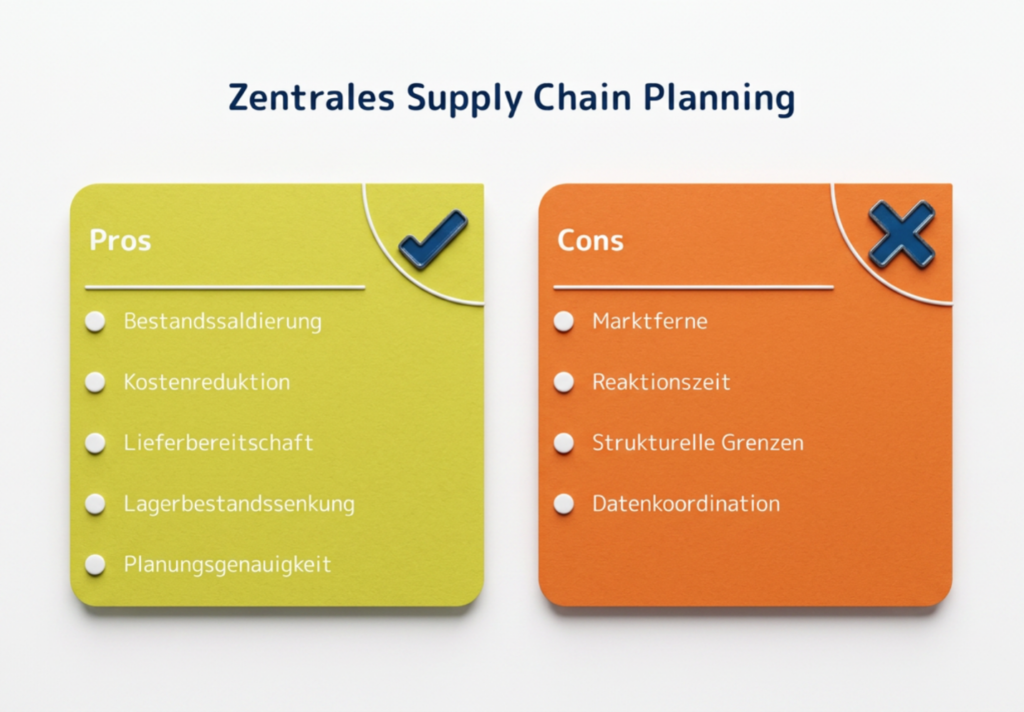
The most measurable benefit lies in stock balancing. When a centralised team oversees the stock levels of all sites, it can offset excess stock at Site A against stock shortages at Site B, rather than building up safety buffers at both ends. Theoretical model analyses confirm that centralised planning policies can reduce total operating costs – comprising warehousing, transport and order processing – compared with decentralised approaches, provided that demand is correlated across sites.
Following the introduction of centralised, demand-driven supply chain planning, JELD-WEN’s on-time delivery rate rose from 35 to 90 per cent. At the same time, planning accuracy improved from 35 to 72 per cent (source: BecomeDemandDriven Case Studies).
In addition to stock balancing, there are further benefits: planning parameters are managed consistently and do not need to be kept up to date simultaneously across five different sites. Planning rules are standardised. Data quality is easier to ensure because a single entity bears responsibility.
Limitations that become apparent in practice
Honesty also requires us to acknowledge the weaknesses. Centralisation concentrates both strengths and risks in equal measure. A central planning team that is too far removed from market developments loses its sensitivity to local demand patterns, short-term customer enquiries or regional peculiarities.
Response times suffer when every local exception has to go through central approval processes. Companies with highly heterogeneous sites, different product groups or highly autonomous regional market structures come up against structural limitations here.
The most common and costly mistake: decision-making authority is centralised, but the data remains decentralised. A central team working with 15 different local data formats creates coordination overheads without realising the benefits of centralisation.
Decentralised planning organisation: flexibility at a cost
A decentralised planning organisation delegates decisions on forecasts, stock levels and resources to regional or business-unit-based teams in order to maximise proximity to local markets and responsiveness.
Decentralised planning offers real benefits. However, it also comes at a cost that is rarely made explicit.
Where decentralised planning creates real value
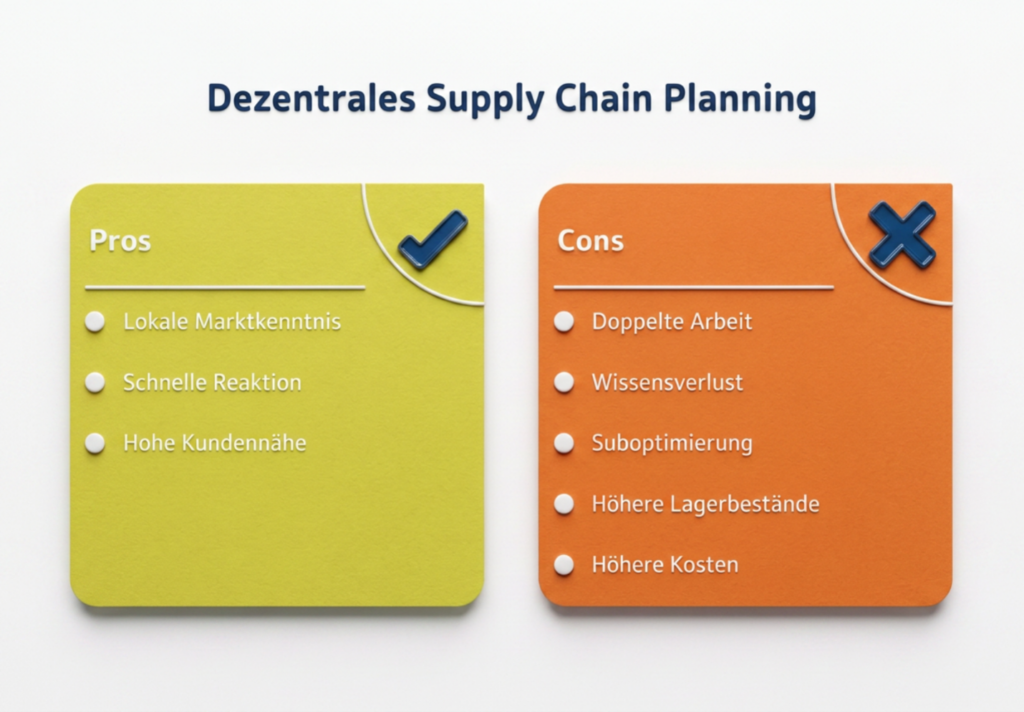
Local planners know their markets. They know that orders from a particular customer always pile up towards the end of the month, that a regional sales representative systematically overestimates forecasts, or that a certain product has seasonal sales in one region, even though national sales figures do not reflect this. This tacit knowledge is difficult to centralise, and losing it comes at a real cost.
Decentralised planning is also quicker when dealing with local exceptions. If a supplier drops out at short notice or a major customer makes a special request, the local planner can react without waiting for feedback from a central office. In sectors characterised by close customer contact and short response times, this is a real advantage.
The hidden costs that are usually not charged for
What is rarely shown on the invoice: several teams maintain similar planning parameters in parallel. Each team develops its own heuristics and sets of rules, which are rarely documented. When an employee leaves the company, that knowledge goes with them.
The serious systemic consequence is sub-optimisation. Each planning unit optimises for itself, whilst the overall system suffers. Stock is built up locally, without regard for whether a neighbouring site has a surplus it could share. Based on our project experience, decentralised planning structures typically result in 10 to 25 per cent higher stock levels than coordinated models, due to a lack of stock balancing.
An APQC benchmark quantifies planning efficiency at a more abstract level: The difference between top performers and bottom performers in terms of planning costs is $2.59 per $1,000 of turnover, with the median figure standing at $1.36. This gap is largely attributable to structural planning inefficiency.
Our article on S&OP problems in practice provides further details on common errors in planning organisation.
Hybrid models: Decentralised in structure, centrally controlled
A hybrid planning model combines central control of forecasting models, inventory parameters and governance rules with decentralised operational execution and local demand sensing.
Hybrid models are not a compromise between the weaknesses of both approaches. They are the logical response to the fact that different planning levels have different requirements.
The key distinction: control logic versus execution
The basic principle can be clearly defined: what is structural, methodological and data-intensive? That belongs at central level. What is locally informed, short-term and customer-specific? That remains decentralised.
In practice, this means that forecasting models, stock levels, planning parameters and their governance are the responsibility of a central team or a Centre of Excellence (CoE). This does not mean that specific planning parameters cannot and should not be fine-tuned on a site-by-site basis. However, the central team defines the rules – in consultation with the sites where necessary – carries out the analyses and maintains the parameters. The embedded local planners carry out the work, make adjustments within the framework of the central guidelines, report exceptions and feed local demand sensing data back into the system.
In a hybrid planning model, a central Centre of Excellence builds up methodological expertise and an analytics infrastructure, whilst regional planners apply the results and incorporate local insights. This model combines uniform standards with decentralised market knowledge.
SKU segmentation as an operational decision-making rule
How does the CoE decide which items are managed centrally and which locally? The answer lies in the product characteristics. Stable, cost-sensitive items with long replenishment lead times benefit from centrally optimised parameters. Volatile, service-intensive items with short response times and a high proportion of local knowledge are better planned locally.
We have been recommending this segmented approach for years: a differentiated planning model based on planning type, which manages stable and volatile items according to different rules. The centralised platform solution at Pankl Racing Systems demonstrates how platform-supported centralisation combined with decentralised execution works in practice.
Technological prerequisite: the shared database
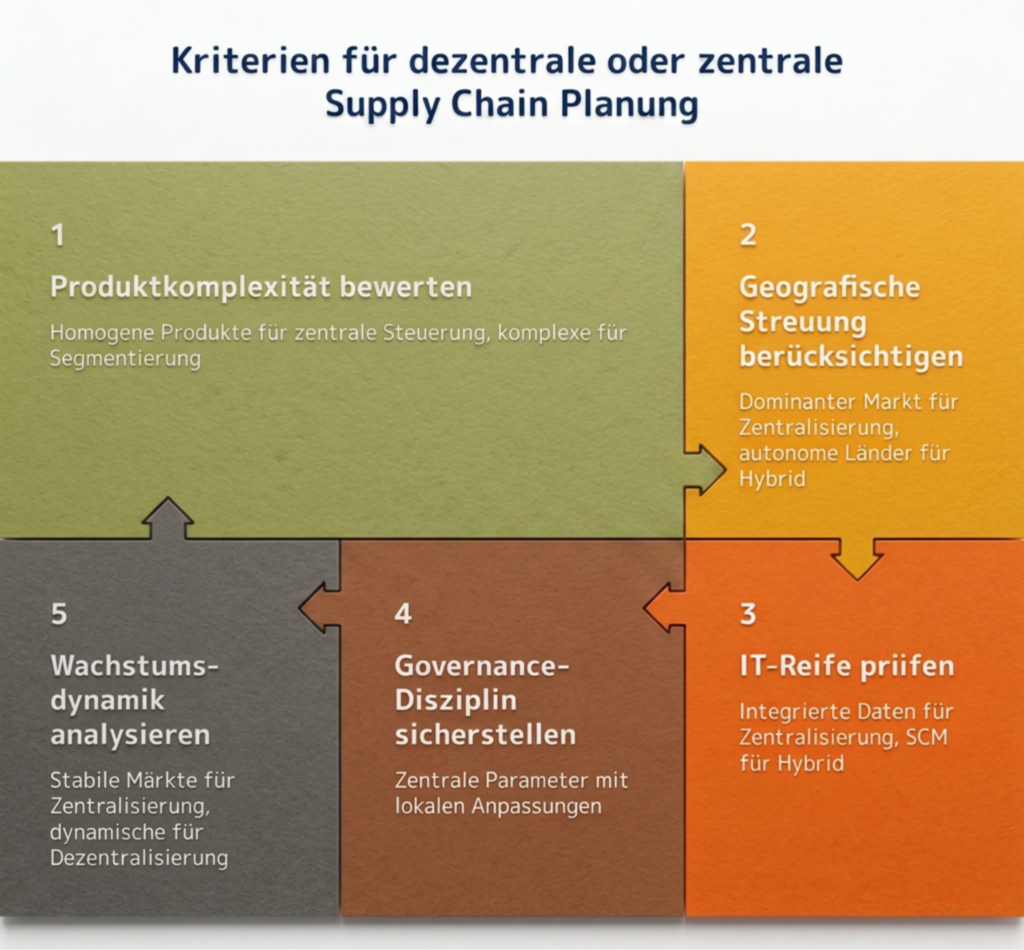
Hybrid models most often fail due to IT realities, long before governance issues become relevant. If local teams work on isolated data silos, the CoE cannot make consolidated decisions. The shared database is not an optional extra, but a fundamental prerequisite.
This does not mean that all sites have to run on a single, standardised ERP system. It is sufficient for a higher-level SCM system to consolidate the data from various ERP instances and make it available to the central management level. When it comes to the quality of central forecasts, data governance takes precedence over data volume. We will discuss the importance of forecast quality as the basis for sound central decision-making in detail in a separate article.
This does not mean that all sites have to run on a single, standardised ERP system. It is sufficient for a higher-level SCM system to consolidate the data from various ERP instances and make it available to the central management level. When it comes to the quality of central forecasts, data governance takes precedence over data volume. We will discuss the importance of forecast quality as the basis for sound central decision-making in detail in a separate article.
Without an integrated database, centralisation is doomed to fail. This is the most frequently underestimated prerequisite. An APQC benchmark study on planning efficiency highlights the difference in efficiency: companies with low process and technology maturity incur additional planning costs of up to $2.59 per $1,000 of turnover compared with the industry leaders. Gartner emphasises that centralisation is built on the three pillars of IT, processes and expertise: if any one of these is missing, costs are incurred without any benefit. It is important to note that it is not necessary for all sites to migrate to a single ERP system. An overarching SCM system that consolidates data from various ERP instances can provide the necessary data foundation for centralised decision-making. IT readiness is the prerequisite for centralisation, not its outcome.
Criterion 4: Governance discipline and accountability for parameters
This point is by far the most critical, and it is most frequently misjudged. In our experience of projects, attempts to ensure consistent planning parameters across the entire group of companies in decentralised units, relying solely on self-discipline, consistently fail. This is evident across all sectors and company sizes.
It is therefore crucial that, at the very least, the planning parameters are set centrally, whilst allowing for local variations to account for site-specific procurement and sales market conditions. If decentralised planners are permitted to override these parameters at all, it must be ensured that they are regularly reset to the central specifications.
The central parameters must not be set on the basis of theoretical considerations or supposed knowledge of the situation. They must be verified and adjusted through simulation. A purely centrally defined parameter template without site-specific fine-tuning does not work in practice either. The right solution lies in a combination of central methodology and simulation-based guidelines, supplemented by local adjustments that are based on the actual procurement and sales market conditions on the ground.
This assessment is based on a direct comparison of planning organisations that function well and those that do not in our projects.
Criterion 5: Growth dynamics
Fast-growing markets characterised by high dynamism and a need for local adaptation benefit from decentralised operational responsibility. Stable, mature markets benefit from centrally optimised parameters. In an international company, this may mean that the mature core business is managed centrally, whilst new growth markets operate with a higher degree of local autonomy.
What to do if the wrong structure has developed over time?
Companies with planning structures that have evolved over time can make gradual changes without the need for a complete reorganisation.
According to a LeanDNA case study, an aerospace manufacturer achieved a liquidity impact of 20 million dollars within 90 days through improved planning coordination and cross-site visibility. This shows that structural improvements in planning deliver rapid results when the right levers are pulled, even without a ‘big bang’ project.
Three levers that deliver immediate results
If you’re unsure where to start, these three operational steps provide a structured approach.
Firstly: clarify the shared data foundation. Which system is considered the master for which data objects? Which interfaces between the ERP and SCM systems are active and reliable? This step may seem unspectacular, but without it, any further measures lack a solid foundation.
Next: review responsibility for parameters. Who maintains which planning parameters for which items? Is there a body that methodically reviews and approves parameter changes? This step often reveals that parameters have not been systematically reviewed for years.
Finally: standardise the planning cycle. When does who plan, on what timeframe, and using what inputs? A standardised planning routine reduces duplication of effort and enables comparability.
Pilot project rather than a roll-out project
The most common pitfall in reorganisations: a company-wide project is launched before the new model has been validated at a single site or for a single product family. We generally recommend starting reorganisations of the planning organisation with a pilot project validated through simulation. A digital twin of the planned new model makes it possible to simulate the effects on stock levels, delivery readiness and planning effort before any real structures are changed.
In our experience, it often becomes apparent that the parameter configuration is the real obstacle, not the choice of organisational model. Knowing this before the roll-out saves considerable costs associated with making corrections.
When external support is advisable
In our experience, anyone who does not have a digital twin of their supply chain or lacks in-depth knowledge of how the planning algorithms in the ERP system and the associated parameters work should seek support from specialists. The combination of structural change and system implementation regularly overwhelms internal teams. Day-to-day business continues as usual, and capacity for change projects is limited.
FAQ – Frequently Asked Questions
What is the difference between centralised and decentralised supply chain planning?
In centralised supply chain planning, a single team centralises all forecasting, stock and resource decisions for the entire organisation. In decentralised planning, regional teams or teams linked to specific business units make these decisions independently. The key difference lies in decision-making authority and responsibility for parameters. Hybrid models combine centralised control logic with decentralised execution.
When is centralised planning appropriate?
Centralised planning is worthwhile if: (1) the product portfolio is homogeneous and demand is correlated across sites, (2) an integrated database exists or can be created, (3) several sites require similar planning parameters and benefit from economies of scale, and (4) the governance discipline required for consistent parameter maintenance cannot be ensured at a decentralised level. It is advisable to carry out a simulation before the changeover.
What are hybrid models in supply chain planning?
Hybrid models combine centralised strategic management with decentralised operational execution. A Centre of Excellence is responsible for methodologies, forecasting models and planning parameters. Regional planners carry out the work, respond to local exceptions and provide feedback on market information. A shared database across all sites is the technological prerequisite for the model to function.
What criteria should be taken into account when choosing a planning organisation?
Five criteria are crucial: (1) product complexity and SKU variation, (2) geographical spread of locations and market structures, (3) IT maturity and the quality of the data base, (4) governance discipline to ensure consistent planning parameters, and (5) the growth dynamics of the relevant markets. A simulation-based preliminary assessment of the planned model significantly reduces implementation risk.
