

Supply Chain Planning in Uncertain Times: Processes, Systems, and Teams
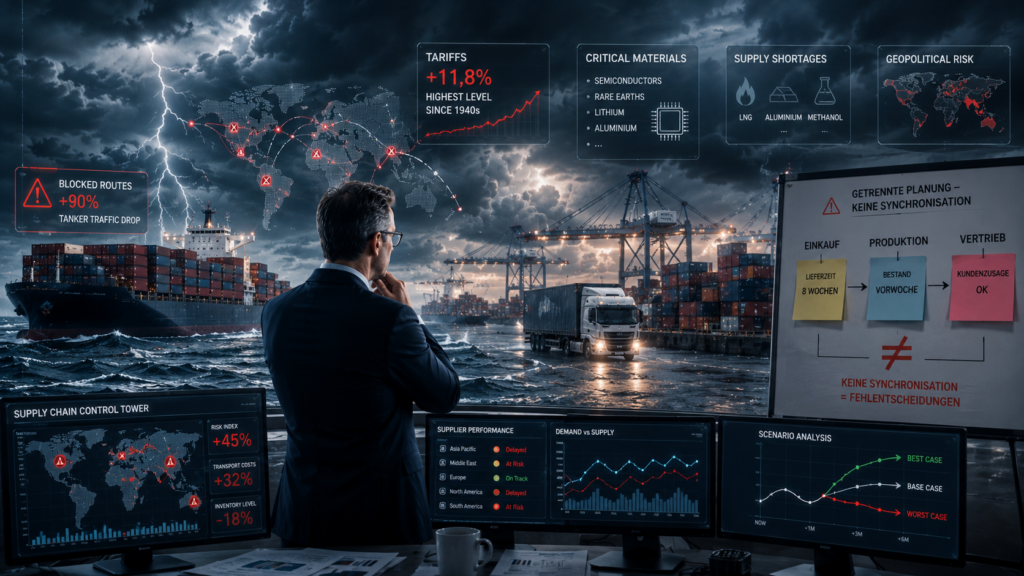
During the chip crisis, we observed the same pattern among several industrial clients: The shortage of components wasn’t the real problem. The real problem was that each department was planning based on different figures. Purchasing relied on outdated lead times, production on the previous week’s inventory, and sales made commitments that no one else was aware of. Yet, in theory, everyone had access to the same data.
Supply chain planning under uncertainty rarely fails due to a lack of information. It fails due to a lack of synchronization. Tariffs, blocked transport routes, delivery restrictions on critical materials, and political uncertainties significantly exacerbate the problem. They extend replenishment times, destabilize scheduling parameters, and force decisions for which traditional planning processes are not designed. Nearly four out of five European companies expect geopolitics, tariffs, and trade policy to impact their supply chains over the next 12 to 24 months, with 13% anticipating a critical impact (Maersk European Supply Chain Survey, December 2025). The pressure to act is real.
This article highlights where concrete action is needed: in planning processes, in software systems, and among the people on the planning team.
What shocks are truly impacting supply chain planning today?
Geopolitical disruptions almost always work through the same mechanism: they extend and destabilize lead times—one of the most critical planning parameters of all. As soon as lead times become unreliable, all planning metrics derived from them lose their meaning. Reorder points are no longer accurate. Safety stock no longer provides protection. Production plans rest on unstable ground.
Tariffs. U.S. tariff policy has shifted multiple times since 2025. In February 2026, the U.S. Supreme Court ruled against the tariffs imposed by Trump; they were replaced by a global 10% tariff. Nevertheless, the effective tariff rate stood at around 11.8% in April 2026—the highest level since the early 1940s (Yale Budget Lab, April 2026). China remains the hardest hit, at around 25% (Penn Wharton, March 2026). It sounds like abstract political maneuvering. For procurement, however, it is very real: Higher landed costs are changing the optimal order quantity, rendering previously sound sourcing decisions obsolete, and forcing a reassessment of entire supplier relationships. Over 50% of manufacturing CFOs in the U.S. stated in the first CFO Survey of 2025 that they were actively diversifying their supply chains, and nearly 40% had brought forward procurement cycles to avoid tariffs (Richmond Fed Economic Brief 25-12, December 2025). Companies in Europe are also feeling the impact, as demand structures are shifting. A sensible short-term response. Without coordinated planning, however, it leads to uncontrolled inventory buildup.
Blocked transport routes. The acute disruption has shifted. Houthi attacks on ships in the Red Sea have subsided since November 2025, and container carriers have cautiously resumed using the Suez route since early 2026. The Strait of Hormuz has taken its place as a globally significant transport bottleneck: Since the U.S.-Israeli attack on Iran on February 28, 2026, and Iran’s announcement of the closure in early March, tanker traffic through the strait has plummeted by around 90%. VLCC tanker rates between the Middle East and Asia reached their highest level in March 2026 since the data series began in November 2005 (EIA, March 2026) . Brent crude has since traded above $90 per barrel, at times exceeding $100. Saudi Arabia is diverting crude oil via the East-West Pipeline to Yanbu, while the UAE is using the Habshan-Fujairah Pipeline. Both bypass routes have limited capacity. The Drewry World Container Index stood at around $2,712 per 40-foot container on May 21, 2026, with the trend rising again. Implications for planning teams: Anyone who has still calibrated their reported inventories to the stable transit times from before 2024 is planning blindly.
Supply bottlenecks for key commodities. The Hormuz crisis is not only affecting the oil market. QatarEnergy has declared force majeure on LNG deliveries. Europe sourced 12 to 14% of its LNG from Qatar; the entire volume previously passed through Hormuz. The World Economic Forum has identified nine additional raw materials directly affected by the crisis, including methanol, aluminum, sulfur, and graphite. All are relevant to the chemical industry, manufacturing, and the energy transition. UNCTAD also warns of higher fertilizer, transportation, and food prices. For planning departments, this means: assessing which of their own procurement components are directly or indirectly affected, and where safety stock levels should therefore be increased.
Critical materials. Semiconductors, rare earths, and strategic minerals are repeatedly at the center of export controls and trade conflicts. What makes this situation unique is its unpredictability: export restrictions can take effect within days, often without sufficient lead time for production adjustments—if such adjustments are even possible. Just-in-time concepts, designed for stable supply chains, reach their limits here.
And the rest: Sanctions, currency risks, energy prices. What all these factors have in common is that they increase the variance in planning inputs and turn static scheduling parameters into sources of error.
What does this mean for planning processes?
A few months ago, in a customer project, we encountered a situation that we have since seen on a regular basis: In some cases, the lead times in the ERP system were a year out of date. No one had updated them because the discrepancy seemed tolerable during normal operations. When the disruption occurred, the system was planning based on parameters that were no longer accurate. Orders were frantically overridden manually, and in the process, a significant portion of the necessary adjustments were simply overlooked, especially in the cascade of C-parts. Nearly half of the companies surveyed during major disruptions reported planning problems directly attributable to outdated or incorrect parameters (McKinsey Supply Chain Risk Pulse, 2025).
This is not a data problem. It is a process design problem.
Condense the planning cycle. A monthly S&OP cycle is designed for stable times. Amid ongoing uncertainty, it creates blind spots of up to four weeks during which reality can diverge significantly from the plan. Those who supplement the S&OP process with weekly safety loops react more quickly to external shocks and force all stakeholders to work with current figures. Important: This is not a second full S&OP process, but a short weekly coordination cycle with a clear focus on outliers and changed assumptions.
S&OP as an orchestra rehearsal. A functioning S&OP process is like an orchestra rehearsal: All instruments must play the same score, and a conductor must hear when someone falls out of step. In our projects, we repeatedly find that this very conductor is missing: a process owner who ensures that all departments work with the same planning assumptions. If purchasing plans with a six-week lead time and production with four, a buffer problem inevitably arises that no one explicitly decided on. Ultimately, the limits of resilience are also a matter of coordination.
Make planning parameters dynamic. Static safety stock levels function like a thermostat set to a fixed temperature. As soon as the outside temperature changes permanently, it heats or cools incorrectly. Dynamic planning parameters automatically adapt to current delivery time variations, rather than being manually reviewed just once a year. Prerequisite: Current transit times and supplier information must be systematically fed into the planning system. In the short term, this means one thing above all: for every stage of the supply chain where replenishment times have changed, immediately adjust the ERP parameters before the next planning run begins.
Define early warning indicators. Which KPI threshold triggers an extraordinary planning round? Companies without defined triggers react in an emergency with ad-hoc decisions, which are almost always more expensive than a plan revision initiated early on. Useful triggers include, for example: a transit time deviation of more than X days from the system parameter, a freight rate increase exceeding a defined threshold, or confirmed customs changes affecting more than Y percent of the procurement volume. How quickly the planning process reacts determines the extent of the disruption. These are key elements of proactive, systematic risk management!
What demands does this new volatility place on software systems?
The most common mistake we see in planning environments is always the same: ERP systems with hard-coded lead time parameters and static safety stock rules that do not reflect the new reality. The system plans as if nothing has happened, while the planning department scrambles to make manual corrections. On top of that: Only 42% of companies today have any visibility beyond their Tier-1 suppliers (McKinsey Supply Chain Risk Pulse, 2025). Those who don’t know what’s happening with Tier-2 suppliers are planning blindly.
Traditional ERP/MRP systems fail under external shocks due to four structural gaps.
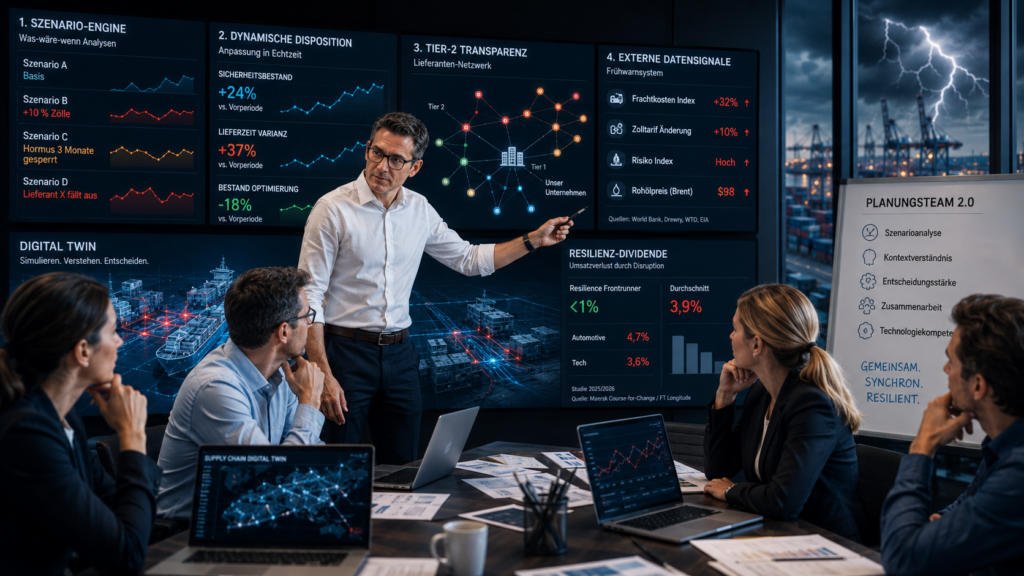
Gap 1: No scenario engine. Standard ERP calculates a plan, but no Plan B. A scenario engine allows multiple scenarios to be modeled in parallel: What happens if the tariff on certain components rises by 10 percentage points and demand drops accordingly? What if Hormus remains blocked for another three months? What if Supplier X goes out of business? These are the foundations for operational decisions, not academic simulations. Those who calculate these scenarios in advance can choose from a prepared option when they occur, rather than having to replan under time pressure.
Gap 2: Static MRP parameters. Safety stock levels, which are reviewed once a year, no longer provide protection in a world where lead times change from month to month. Modern APS systems such as DISKOVER dynamically adjust planning parameters to delivery time variance. The result from our project experience: parameter optimization alone can reduce inventory levels by 15 to 30% without compromising delivery readiness. The methodology also works under increased uncertainty: the difference lies in the update frequency.
Gap 3: Limited supplier visibility. Those who only have Tier-1 suppliers in the system will not see the failure of a Tier-2 supplier until the Tier-1 supplier is forced to report its own inability to deliver. Early warning signals come from the deeper network. To get started, a manual Tier 2 mapping of the 10 to 20 most critical materials is often sufficient. The real challenge is obtaining the information in the first place, as many suppliers treat their upstream suppliers as a key trade secret.
Gap 4: No external data signals. Current freight rates, customs tariff databases, and risk indices such as the World Bank Global Supply Chain Stress Index provide valuable early warning signals. Systems that process only internal transaction data do not perceive the outside world until it has long since been reflected in the internal figures.
An effective tool for preparing for disruptions is a digital twin of one’s own supply network. In this context, a digital twin is what a flight simulator is to pilot training: scenarios can be run through risk-free before real decisions are made. In its 2025 Course for Change study (surveying over 900 global supply chain executives, in collaboration with FT Longitude), Maersk identifies a measurable resilience dividend: companies classified as “resilience frontrunners” lost less than 1% of revenue during disruptions, while the average was 3.9%. In industry-specific follow-up surveys from 2026, the disparity becomes even clearer: the automotive sector saw an average revenue loss of 4.7% due to disruption, while the tech sector saw 3.6%. The frontrunners are not distinguished by a single tool, but by an interplay of leadership, technology, and collaboration—and it is precisely this interplay that the Digital Twin makes operationally tangible.
What new challenges are emerging for planning teams and organizations?
In the past, supply chain planners adjusted order proposals from the ERP system, occasionally created orders themselves, and managed safety stock. This was important work within a manageable scope. Today, those same planners navigate scenarios with incomplete information, under time pressure, and with significant consequences if they make the wrong decisions. These are fundamentally different requirements.
New Core Competencies
Scenario analysis isn’t something you learn in an ERP course. It requires structured thinking under uncertainty: What assumptions underpin the plan? Which ones are particularly vulnerable? What are the consequences if this assumption fails? Planners who systematically ask these questions are indispensable in a volatile world.
Understanding the political context sounds like the work of a consultant, but it isn’t. A planner who understands why semiconductor restrictions between certain countries are politically likely can incorporate that into the security stockpile strategy. It’s not about becoming a geopolitical analyst. It’s about developing a sense of the mechanics of trade conflicts and sanctions.
Decision-making ability in the face of ambiguity is the third core competency. Those who wait until all information is available make decisions too late. Good planners work with clear decision-making rules in uncertain times: “If X occurs, we escalate to measure Y.” These rules must be defined and agreed upon in advance, not only in the event of a crisis.
The S&OP Process Owner as Helmsman
A rowboat with eight rowers and no helmsman will never reach its destination quickly and safely. But that is exactly what happens in planning organizations without a clear S&OP owner. The Process Owner—let’s call them the S&OP conductor—ensures that all departments use the same up-to-date plan as a foundation and escalates deviations before they turn into crises. According to the ISM Guide to Resilience Competencies and S&OP Governance, clear governance structures and defined decision-making pathways are among the key distinguishing features of resilient companies. What the latest European survey data says on this: 75% of European companies are now diversifying their sourcing geographically (up from 53% in 2024), and 80% are consciously deepening their relationships with logistics providers and key suppliers (Maersk European Supply Chain Survey, December 2025). Both approaches only work if someone orchestrates these activities; otherwise, parallel initiatives arise without a combined impact.
Knowledge Transfer and Documentation
What was learned during the last crisis should not disappear into the mind of a single planner. Short disruption logs (“What was the event? What did we decide? What did we learn from it?”) build up a playbook library over time that the entire team can use. Those who additionally embed multi-level inventory optimization (MEIO) within the team create systemic stability that no longer depends on individuals.
What specific steps can companies take right now?
Supply chain planning under uncertainty requires action across three time horizons. In the short term, companies can adjust lead times and reorder points, increase safety stock, and prepare alternative routes. In three to six months, the focus shifts to S&OP cadence, scenario libraries, and supplier mapping. In the medium term, multi-sourcing and system enhancements are on the agenda. McKinsey quantifies the typical response patterns: 45% of companies affected by customs issues increase their inventory levels, 39% establish dual sourcing, and 33% develop nearshoring plans (McKinsey Supply Chain Risk Pulse, 2025).
Immediately (this week)
First: Compare current replenishment lead times with ERP values. Correct any deviation exceeding 10% immediately. Second: For critical A-parts, verify whether the stored safety margin still covers the new transit time variance. If not, increase it immediately. Third: Define at least one validated alternative route for the five most important transport routes and factor its lead time delta into the safety stock calculation. That is all that is needed in the short term—and anything less is insufficient.
In three to six months
Supplement the S&OP cycle with weekly loops, focusing on parameter deviations and new risk signals. Create a scenario library: run calculations for at least three scenarios (tariff increase +X%, route blocked, supplier failure) and define a decision rule for each scenario. Initiate Tier 2 mapping for the 10 to 20 most critical materials. The World Bank Global Supply Chain Stress Index serves as a free, regularly updated early warning signal at the country and route level.
Medium term (six to eighteen months)
Consistently build out multi-sourcing for the ten most critical risk materials and embed it as a regular procurement strategy. And don’t wait until the crisis hits. Assess nearshoring potential where transport risk and customs exposure are particularly high. Expand the APS system with scenario capabilities. Those without a multi-sourcing option bear the full risk alone.
Our recommendation in a nutshell: Start with what is currently misconfigured—such as replenishment lead times and safety stock levels—before purchasing new systems or restructuring supply chains. Parameter optimization alone can reduce inventory levels by 15 to 30% without compromising delivery readiness. This offers the greatest leverage with the lowest risk.
Key Takeaways
Supply chain planning is under constant pressure from external shocks. Those who act now can avoid competitive disadvantages:
The acute disruption has shifted from the Red Sea to the Strait of Hormuz. Since the Iran War in February 2026, tanker traffic through Hormuz has plummeted by around 90%, VLCC tanker rates between the Middle East and Asia are at an all-time high since the data series began in 2005, and Brent is above $100 per barrel. All scheduling parameters based on stable replenishment times need to be recalibrated.
U.S. tariff policy remains volatile. The effective tariff rate in April 2026 stands at around 11.8% (Yale Budget Lab), the highest level since the 1940s, despite the Supreme Court ruling against the Trump tariffs in February 2026.
Planning cycles and S&OP synchronization can be adjusted immediately. Weekly planning loops and a clear S&OP owner require no software, only process discipline. Dynamic safety stocks reduce buffers in a targeted manner rather than across the board.
ERP alone is not enough for volatile supply chains. Modern APS systems need four things: a scenario engine, dynamic scheduling parameters, Tier 2 visibility, and external data signals.
Planning teams need new skills. Scenario analysis, decision-making confidence in ambiguous situations, and a clear S&OP leader are operational necessities. Maersk data shows: Resilience frontrunners lost less than 1% of revenue during disruptions, while the average was 3.9%.
Immediately actionable: Correct lead times in the ERP system, review and increase safety stock for critical A-parts, and document alternative routes. 45% of companies affected by customs issues are increasing their inventory, 39% are establishing dual sourcing, and 33% are developing nearshoring plans (McKinsey, 2025).
Of course: What reads so clearly here is rarely simple in practice. But those who have succeeded—and suddenly experience better delivery readiness, fewer stockouts, and greater trust between departments—know: The effort is worth it!
Sources
Drewry Shipping Consultants, World Container Index Weekly Update, 21. Mai 2026.
EIA – U.S. Energy Information Administration, Middle East crude oil tanker rates reached a multi-decade high in March, 26. März 2026.
Maersk in Kooperation mit FT Longitude, Course for Change: Mastering Supply Chain Resilience in an Unconventional World, Juni 2025.
Maersk European Supply Chain Survey, Supply Chain Challenges 2026, Dezember 2025.
McKinsey & Company, Supply Chain Risk Pulse 2025: Tariffs Reshuffle Global Trade Priorities, 2025.
Penn Wharton Budget Model, Effective Tariff Rates and Revenues, Update Mai 2026.
Richmond Fed, Economic Brief 25-12: Tariffs – Estimating the Economic Impact of the 2025 Measures and Proposals, Dezember 2025.
UNCTAD, Strait of Hormuz Disruptions: Implications for Global Trade and Development, März 2026.
U.S. Congressional Research Service, Iran Conflict and the Strait of Hormuz: Impacts on Oil, Gas, and Other Commodities, März 2026.
World Economic Forum, Beyond Oil: 9 Commodities Impacted by the Strait of Hormuz Crisis, April 2026.
Yale Budget Lab, State of U.S. Tariffs: April 8, 2026.
FAQ – Frequently Asked Questions
How exactly do tariffs affect supply chain planning?
Customs duties increase the landed costs of imported components – and thus have a direct impact on sourcing decisions, inventory valuations and reorder points. If a customs duty rate rises at short notice, optimal order quantities and supplier choices change. MPS planners must adjust their ERP parameters immediately; otherwise, incorrect cost bases will lead to incorrect ordering decisions. See the section on planning processes above for more on this.
Which planning software can help with geopolitical risks?
Modern APS systems must have four capabilities to make geopolitical risks manageable: firstly, a scenario engine for ‘what-if’ analyses; secondly, dynamic planning parameters that automatically adapt to changes in lead time variations; thirdly, visibility of Tier 2 suppliers; and fourthly, the integration of external data signals such as freight rates or risk indices. ERP alone does not usually provide this.
What is the difference between supply chain resilience and efficiency?
Efficiency minimises costs under stable conditions. Resilience maintains supply capacity in the event of disruptions. These two objectives are at odds with one another: increasing resilience through higher stock levels or additional suppliers incurs short-term costs. Striking the right balance depends on the company’s specific risk profile. Abels & Kemmner recommends prioritising investments in resilience based on a clear cost-benefit analysis, rather than building up buffers across the board.
As a small or medium-sized business, how do I plan alternative transport routes?
Planning alternative routes requires three preparatory steps. Firstly: identify critical routes and assess their risk exposure (probability and impact). Secondly: pre-negotiate alternative carriers and routes before a crisis strikes, rather than waiting until afterwards. Thirdly: factor the lead time difference of the alternative route into safety stock calculations, as alternative routes almost always take longer. Those who carry out this work during normal operations save valuable days in a crisis.