
Competitiveness is not fate – it is a management decision
Germany’s competitiveness is not failing because of technology, talent or markets, but because of leadership. What engineers and systems could achieve today is being systematically thwarted by short-sighted, risk-averse and un-entrepreneurial commercial decision-making logic.
Germany and Europe have been struggling with a structural problem for years: declining competitiveness and stagnating productivity. The diagnosis is well known, the complaints are ritualised, and the explanations are readily available. Sales markets are collapsing – in the USA because of tariffs, in China because they can now produce what they used to import from Europe. At the same time, competition is increasing in all global markets, especially from Chinese suppliers who have caught up technologically or have already overtaken Europe in many areas.
These observations are not wrong. But they fall short. They describe symptoms, not the cause.
If Europe – and Germany in particular – had consistently maintained and developed its technological lead, many of these problems would be manageable. Products with genuine technological added value can be sold even with tariffs. They are in demand worldwide, even in highly competitive markets. The real core of the problem lies not in foreign trade, but within our companies: we are losing our technological edge because we are not systematically defending and expanding it.
Productivity: The unresolved core problem
This failure is particularly evident in productivity. In my own field of expertise, supply chain management and supply chain planning, the productivity gap has been evident for years. Processes are fragmented, planning systems are outdated, and decision-making logic is manual, data-poor and slow. At the same time, the state of the art is more advanced than ever: modern planning algorithms, AI-supported forecasts, end-to-end transparency, simulation-based decision support.
The technological gap could be closed – in theory. In practice, it is not being closed. Not because there are no solutions. Not because engineers or computer scientists are overwhelmed. But because projects systematically get stuck: budgets are not approved, business cases are talked to death, pilot projects are not scaled up. Valuable time is lost – and with it, competitiveness.
The false causality: markets as an excuse
In many boardrooms, the cause of the misery is externalised. The loss of the Chinese market is considered virtually inevitable. The protectionist course of the USA is treated as an exogenous shock. Growing competition is accepted as a new reality to which one must simply adapt.
This view is convenient, but dangerous. It fails to recognise the crucial connection: markets do not collapse because they become ‘politically difficult’. They collapse because products lose their relative added value. China is buying fewer machines from Europe because Chinese manufacturers now supply comparable or better products – often cheaper, faster and better integrated into digital ecosystems.
Those who lead in technology set standards. Those who set standards are less dependent on tariffs, subsidies or political sentiment. Technological leadership is no guarantee, but it is the most effective protection against margin erosion and interchangeability.
What CEOs themselves say – and yet fail to implement
Interestingly, this diagnosis has certainly been acknowledged in the boardrooms. The latest PwC Global CEO Survey shows that around 42% of CEOs see their biggest concern as whether their company can transform quickly enough to keep pace with technological change. Transformation is therefore recognised as a risk.
At the same time, the mood in Germany is particularly pessimistic. Only a minority of German CEOs expect growth in their own companies, while a majority (56%) even expect the domestic economy to decline. However, this combination of fear of transformation and pessimism about growth does not lead to decisive renewal, but to investment paralysis.
The result is paradoxical: transformation is considered necessary, but is postponed. Technology is tested, but not scaled. Projects are started, but no decisions are made.
Technology is no longer the bottleneck
The PwC CEO Survey 2026 sums it up clearly: simply using technology is no longer enough. Competitive advantage comes from the speed of implementation and the ability to scale new technologies – especially AI – in such a way that they have a measurable impact on the balance sheet.
In other words, technology is no longer the bottleneck. Leadership is.
Many companies remain in a mode of controlled hesitation. Pilot projects are presented as proof of innovative capability without ever really changing the organisation, processes and decision-making logic. AI is allowed to experiment, but not to influence operational business. Planning tools are allowed to visualise, but not to decide. As a result, there is no productivity effect.
The real obstacle: commercial short-sightedness
This is where the issue becomes uncomfortable. The obstacle is not technology, but rather the commercial decision-making logic of many companies. Investments in technology are primarily evaluated based on short-term ROI, often measured over a single financial year. Uncertainty is not accepted as a business reality, but rather used as an argument for not making a decision.
This is particularly evident in areas such as supply chain planning. The benefits of modern planning systems do not come from licence costs or savings in the first year, but from better decisions, lower inventories, higher delivery capacity and resilience. These effects are real, but they cannot always be reflected in classic business case tables based on linear assumptions.
The result: people opt for the financially ‘safe’ option – and the strategically wrong one.
From merchant to entrepreneur – or vice versa
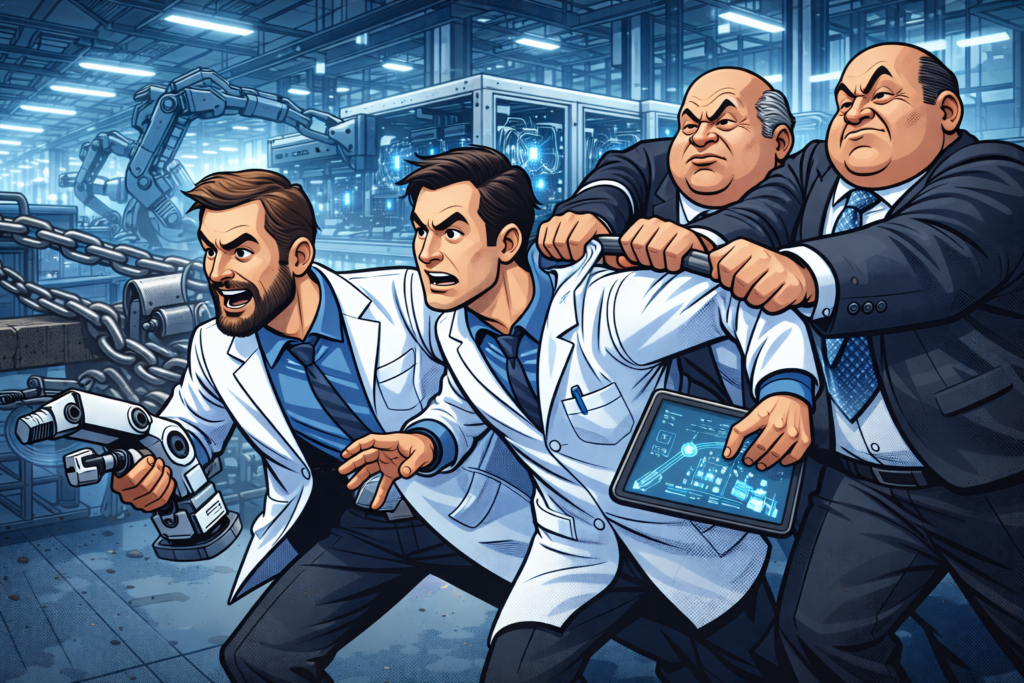
It used to be said that ‘engineers are the donkeys on which merchants ride to economic miracles.’ That was never flattering, but it hit a nerve: merchants and engineers worked in a productive tension that enabled growth.
Today, this relationship has shifted. The businessman has supplanted the entrepreneur. Security trumps creativity, control trumps responsibility, cost avoidance trumps value creation. In this logic, technological potential is not exploited but neutralised – by committees, approval loops and risk assessments that stifle any dynamism.
To put it bluntly: businesspeople are becoming oxen that trample the technological and economic potential of engineers before it can take effect.
Competitiveness is a decision
The key insight is uncomfortable, but clear: Germany’s and Europe’s competitiveness is not failing due to a lack of technology, talent or even external conditions. It is failing due to a management culture that recognises transformation but does not act consistently.
Technological advantage does not come from soapbox speeches, innovation labs or pilot projects. It is created through clear priorities, courageous investment decisions and a willingness to tolerate uncertainty. Above all, however, it is created through speed.
Anyone who is still discussing whether they ‘need’ modern supply chain planning, AI-supported decision-making models or integrated end-to-end systems has already asked the wrong question. The real question is: how long can we afford not to decide?
Competitiveness is not a matter of fate. It is the result of leadership decisions – or the lack thereof.