

Inventory management is the responsibility of the management
Silvia Frankenne, Dirk Ungerechts and Peter Szczensny
Inventories are not a logistical detail. They are strategic decisions in material form.
In many companies, inventory management is understood as an operational discipline – as a task of scheduling, planning or supply chain management. In fact, inventories materialise operationally through forecasts, scheduling parameters and planning logic. However, their level and structure are rarely solely a question of parameter settings.
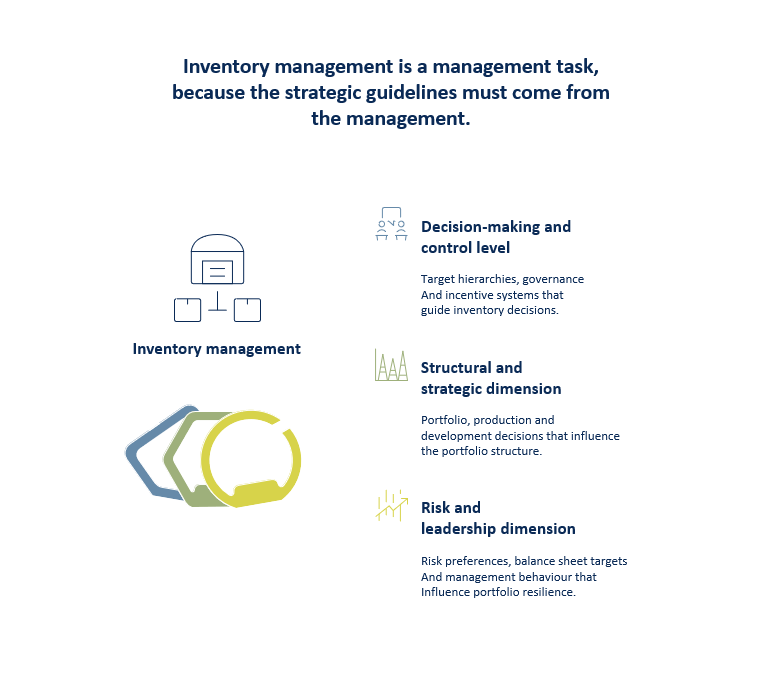
Inventories are shaped on three levels:
at the decision-making and control level by target hierarchies, governance and incentive systems;
at the structural and strategic level by portfolio, production and development decisions;
and at the risk and management level by risk preferences, balance sheet targets, resilience considerations and actual management behaviour.
Disposition parameters are thus the visible lever – but not always the actual cause. Anyone who wants to manage portfolios sustainably must shape the drivers behind these parameters: decision-making rules, strategic decisions and leadership priorities.
Portfolio management is therefore not a purely operational function – it is a management task.
I. Decision-making and control dimension
Inventories arise where conflicting goals are not resolved, decision-making rules are not clearly defined, and control systems are not holistically aligned. Although they materialise operationally through scheduling parameters, their structural cause often lies at the management level: in a lack of goal hierarchies, inconsistent governance, or incentive systems that promote partial optimisation rather than overall optimisation. Where priorities are not bindingly defined, inventories arise as an implicit compromise between conflicting requirements. Inventory management at this level therefore means consciously designing the control architecture and making binding decisions on conflicting goals – an original task of management.
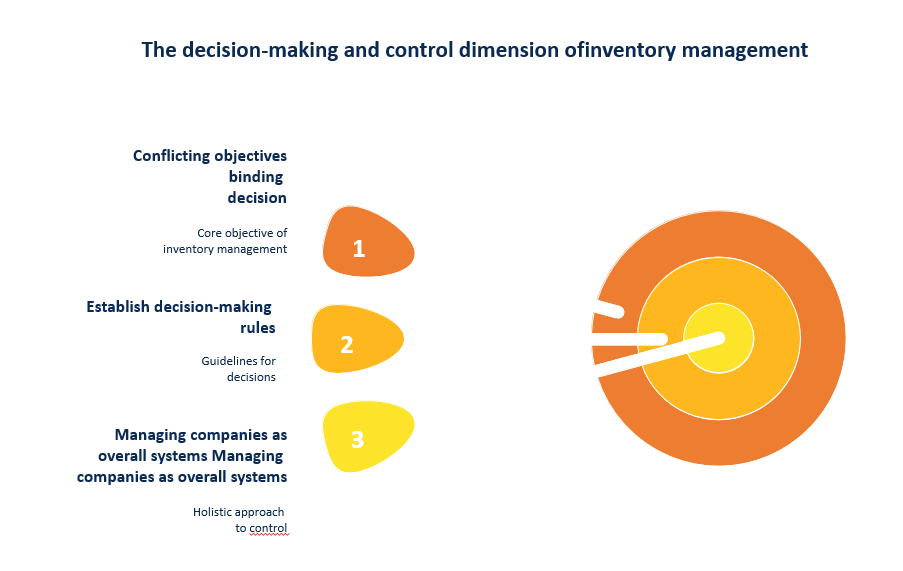
1. Inventory management means: making binding decisions on conflicting goals.
Inventories are rarely the result of ‘poor planning’. In most companies, they are the material consequence of conflicting goal systems that are pursued simultaneously.
-Sales demands maximum delivery capacity, short delivery times and a wide range of variants.
-Production optimises capacity utilisation and large batches – and thus inevitably generates advance and circulating inventories.
-Purchasing bundles quantities to achieve price advantages – often at the expense of inventory and risk costs.
-SCM and planning, on the other hand, are supposed to reduce inventories and create stability – even though the structural drivers remain untouched.
-Product management and development drive differentiation – without consistently evaluating the inventory consequences in their decisions.
Each of these perspectives is rational in itself. The problem is that they cannot be maximised simultaneously.
If a company does not explicitly decide on this conflict of objectives, the organisation resolves it implicitly – almost always through inventories: as safety stock, as overproduction, as a buffer between departments, as a ‘painkiller’ against planning uncertainty.
Inventories are therefore not only a result of processes, but also a result of a lack of prioritisation.
Management logic:
Inventory management therefore means establishing a hierarchy of objectives: What applies in case of doubt? Delivery capability? Capital commitment? Capacity utilisation? Variety of variants? Price?
This prioritisation cannot be delegated to specialist departments because each department has to make different decisions based on its role. Only the management can and must set binding target priorities across the company – and, above all, defend them in the event of a conflict.

2. Inventory management means defining the company’s decision-making rules.
Inventories follow rules. These rules are not always visible, but they are effective.
The level of inventories is largely determined by:
Service level definitions: A target service level of 98% generates structurally higher safety stocks than 94%.
Planning and forecasting methods: How uncertainty is modelled determines risk premiums.
Planning parameters: Safety factors, minimum lots, replenishment times.
Escalation mechanisms: Who decides in the conflict between delivery capability and inventory reduction?
Governance structures: Who has decision-making rights? Who bears the consequences?
Incentive systems: Are inventories perceived as a problem or as a safeguard?
If these rules are not explicitly defined, implicit standards arise – often with systematic inventory inflation.
The situation becomes particularly critical when rules are changed depending on the situation:
A strategically defined service level is overridden at the end of the year by short-term balance sheet targets. The operational level receives conflicting signals – and reacts by creating buffers or target uncertainty.
Management logic:
Inventory management means clearly defining the company’s decision-making architecture and applying it consistently.
Rules on service levels, risk, escalation and responsibility are not operational details – they are an expression of governance.
And governance is the responsibility of management.
3. Inventory management means managing the company as a whole system – not as the sum of individual areas.
Many companies suffer not primarily from incorrect objectives, but from the way they are managed. Even if target hierarchies are defined, area-specific optimisation often leads to structural inventory build-up.
This is because each organisational subsystem acts rationally within its own management logic:
-Plants optimise capacity utilisation and reduce unit costs – even if this increases circulating inventory.
-Sales units secure their service targets locally – even if this results in additional safety stocks.
-Purchasing departments bundle quantities to optimise prices – regardless of the capital commitment.
-Regional organisations create their own buffers to protect themselves against uncertainty.
In each individual case, the behaviour is understandable from a business perspective. The problem arises when these rationales are not integrated systemically. Then safety stocks add up along the value chain. Buffers accumulate at every stage. Local target achievement creates global inefficiency.
The problem is not a lack of discipline, but rather the architecture of the control system. When incentive systems, key performance indicators and responsibilities are designed on a divisional basis, partial optimisation is inevitable. Inventories become the ‘lubricant’ between divisions.
Inventory management is therefore also a question of system design:
-How are cross-departmental conflicts of interest assessed?
-Which key performance indicators dominate?
-Where is overall optimisation prioritised over departmental optimisation?
-What are the consequences of behaviour that is detrimental to the system?
Management logic:
Only the management can think of and control the company as a whole system.
Inventory management requires a willingness to align control and incentive logic in such a way that it promotes overall optimisation – not just local efficiency.
System optimisation is not an operational task, but a structural management decision.

II. Structural and strategic dimension
Inventories are the structural consequence of portfolio, production and development decisions. They do not arise in isolation in logistics, but as a material consequence of strategic decisions: product diversity increases complexity, production logic determines circulating inventories, and investment decisions shape long-term capital commitment. At the same time, inventories define a company’s strategic freedom and reflect which priorities are actually being pursued – regardless of formulated strategy papers. Those responsible for strategy are therefore also responsible for its material manifestation in inventory.
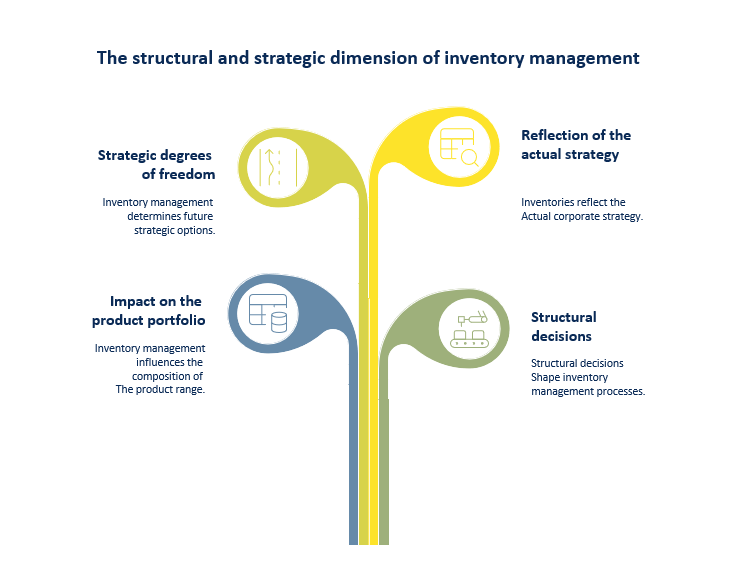
4. Inventory management inevitably affects the product portfolio
Anyone who wants to reduce inventory sustainably will very quickly reach a limit: much of the inventory is not logistical ‘fine-tuning’ but a structural consequence of the product portfolio.
Each additional variant not only generates more item numbers in the system. It also generates:
-additional forecast uncertainty, because demand per variant becomes smaller and more volatile,
-more safety stocks, because each variant is secured separately,
-more changeovers, more minimum lot sizes, more residual stocks,
-more complexity in purchasing, production, warehousing and sales.
This inevitably makes inventory management a strategic issue:
-Which variants justify their inventory and capital commitment?
-Which products are strategically relevant – and which are just ‘tagging along’?
-Where does differentiation generate real customer value – and where does it primarily generate internal complexity?
These questions are not purely ‘supply chain’ issues. They touch on market positioning, sales orientation, product strategy and, in many industries, the brand promise. Specialist departments can provide data and work out options – but the decision is a strategic portfolio decision.
Management logic:
Without portfolio intervention, inventory management often remains a matter of treating the symptoms: optimising scheduling parameters, implementing project “clean-ups” and campaigns, but the structural source of inventory remains. A lasting effect can only be achieved if management is prepared to link inventory targets to portfolio decisions – and thus consciously limit complexity.

5. Inventory management is a question of structural production and development decisions.
Many companies try to reduce inventories operationally: through better forecasts, tighter scheduling, sales promotions or inventory clearance programmes.
What is often overlooked here is that
a significant portion of inventories is not caused by operational factors, but is structurally predetermined.
Inventory arises from fundamental decisions such as:
Batch size and set-up strategies: Large batches reduce unit costs but increase circulating and finished goods inventory.
Make-or-buy decisions: In-house production ties up capital in preliminary stages; external procurement shifts risks and minimum quantities to other structures.
Modularisation and common parts strategies: A lack of standardisation multiplies variants and safety stocks.
Modular and variant architectures: Product design defines the complexity and inventory logic in the long term.
Investment decisions: Automation, capacity expansion or specialisation have an impact on the inventory structure for years to come.
Inventories are therefore not an isolated logistics issue. They are the material consequence of strategic structural decisions in production and development.
Anyone who declares high capacity utilisation to be their top priority must accept that inventories become a stabilising factor.
Those who promise maximum variant flexibility must bear the capital commitment and forecast uncertainty.
Management logic:
Structural decisions with cross-departmental effects cannot be treated as operational optimisation of individual departments.
Inventory management here means consciously deciding which production and development logic the company wants to pursue in the long term – and which inventory consequences are acceptable as a result.
6. Inventory management determines future strategic freedom
Inventories are tied-up capital.
But they are more than that: they are tied-up assumptions about the future.
Every inventory is based on an implicit expectation:
-that products will sell as planned,
-that markets will remain stable,
-that certain variants will remain relevant,
-that price levels can be maintained,
-that supply chains will function.
As long as these assumptions hold true, inventory appears to be a factor of stability.
As soon as conditions change, however, it becomes a strategic obstacle.
High inventory levels:
-tie up liquidity and reduce scope for investment,
-prolong response times to market changes,
-make price corrections more expensive due to write-downs and sales,
-focus management attention on inventory problems,
-increase exit costs from markets or product segments.
Lower, specifically managed inventories, on the other hand, increase:
-freedom of capital allocation,
-speed of adaptation,
-strategic optionality.
Inventories therefore define not only the current capital commitment, but also the real scope for action in the future.
Management logic:
The desired level of strategic flexibility is a conscious management decision.
Those who strive for a high degree of strategic freedom must be prepared to manage inventories accordingly.
Inventory levels are therefore an expression of the chosen strategic optionality.

7. Inventories reveal the actual, current strategy – not the stated one.
Strategies are formulated, presented and communicated.
Inventories, on the other hand, are the material implementation of this strategy – or its deviation.
Inventories reveal the following:
High variant inventories indicate a factual prioritisation of differentiation.
High safety inventories indicate a factual risk preference.
High finished goods inventories indicate a de facto push logic.
Disproportionate inventories in certain markets indicate real prioritisation.
Inventories of discontinued products indicate a lack of portfolio consistency.
Inventories reveal which target hierarchies are actually being implemented – regardless of what has been formulated strategically.
They are therefore a mirror of the organisation:
Do service targets match actual inventory behaviour?
Does the level of risk correspond to the defined strategy?
Is capital allocation practised as it is communicated?
Inventories reveal inconsistencies between strategic rhetoric and operational reality.
Management logic:
Portfolios are a permanent feedback system for management.
They show whether the formulated strategy is actually being implemented – or whether implicit priorities determine actions.
Those responsible for strategy must be prepared to be measured by the portfolios.
III. Risk and management dimension
Inventories are an expression of both risk decisions and management behaviour. They arise not only from operational necessities, but also from organisational defence mechanisms, balance sheet targets, implicit risk preferences and the question of how consistently strategic guidelines are actually implemented. They influence liquidity, capital commitment and crisis resilience, while also revealing whether priorities remain stable even under pressure. Inventories thus show not only what risks a company is willing to take, but also how consistent its management is. Resilience, financial control and target integrity are embodied in inventory – making inventory management an integral part of management responsibility.
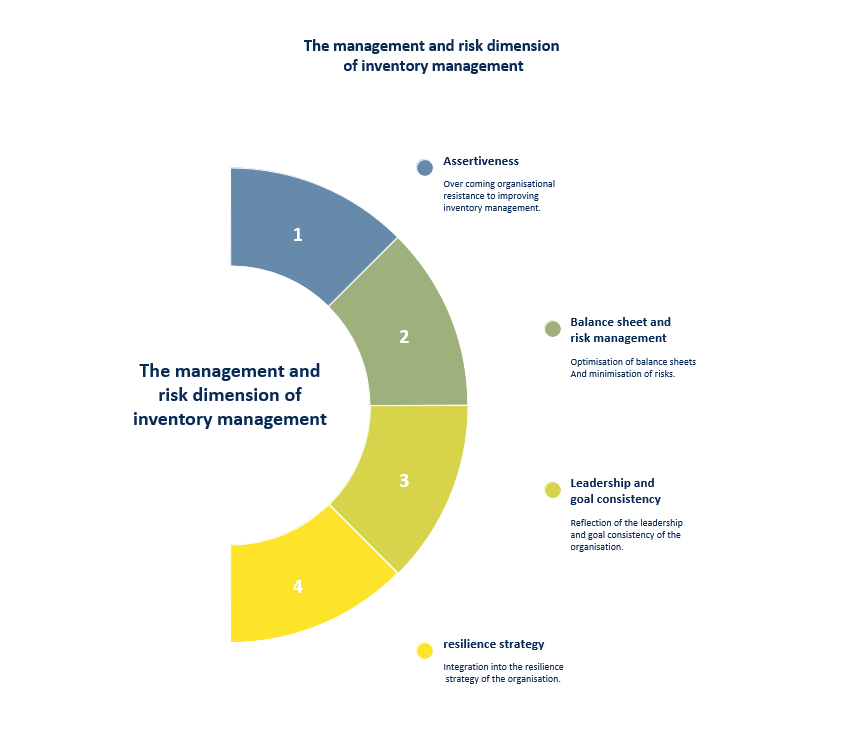
8. Inventory management requires assertiveness in the face of organisational resistance.
Inventory management is not purely an analytical issue.
It involves interfering with existing compromises, power balances and routines.
Once transparency about the causes of inventory has been established, the following typically happens:
-Implicit assumptions become explicit – and thus vulnerable to attack.
-Responsibilities become visible – and thus personalised.
-Conflicting goals become apparent – and must be resolved.
-Departmental logic is called into question.
Reactions are rarely openly confrontational. More often, they are subtle:
-Simulation results are methodically questioned.
-Assumptions are relativised.
-Key figures are reinterpreted.
-Decisions are postponed.
-Projects run their course in day-to-day operations.
This is not a sign of incompetence. It is a normal organisational psychological pattern:
Stocks stabilise conflicting goals. Reducing them destabilises existing balances.
Inventory management thus interferes with established arrangements – and generates resistance.
Management logic:
Without clear support and active participation from management, structural inventory initiatives remain ineffective.
Only when it becomes clear that conflicting goals are being decided and supported at the highest level do implicit buffers lose their legitimacy.
Inventory management is therefore always a question of management authority and consistency.

9. Inventory management is balance sheet and risk management
Inventories appear to be operational – they are stored in warehouses, halls and on shelves.
In reality, however, they are primarily a balance sheet item and a risk factor.
Inventories have a direct impact on:
Liquidity and cash flow,
Working capital and return on capital,
Equity tied up,
Depreciation and obsolescence risks,
Earnings volatility in the event of market fluctuations,
The company’s resilience to crises.
Every increase in inventory is a capital allocation decision – in favour of warehousing and at the expense of alternative investments.
At the same time, inventories always involve a future risk:
they are based on assumptions about demand, product life cycles, price developments and delivery capabilities.
If these assumptions do not materialise, risks materialise in the form of write-downs, devaluations or liquidity bottlenecks.
Inventories are therefore not an operational by-product, but part of the company’s overall financial management.
Management logic:
The balance sheet, capital commitment and risk profile are the responsibility of the management.
Inventory management is therefore not purely an SCM issue, but part of strategic financial and risk management.
10. Inventory management reflects the consistency of the organisation’s leadership and objectives
Inventories are not only created by structures, rules or conflicting objectives. They are also created by the actual behaviour of management – especially when dealing with contradictions and short-term pressure.
A typical pattern can be observed in many companies:
Strategically, a high delivery capability is defined. This implicitly results in a certain inventory level. At the same time, massive pressure is exerted at the end of the financial year to reduce inventory – without regard for the resulting delivery capability in the following period.
This sends contradictory signals to the operational level:
-Ensure delivery capability – but reduce inventory.
-Maintain service levels – but reduce working capital.
-Maintain market share – but avoid tying up capital.
In such situations, the result is not rationally managed inventories, but reactive buffers or strategic inconsistencies. Employees learn that strategic targets are relativised depending on the situation. Conflicting goals are not resolved, but postponed.
Holdings thus become an indicator of leadership behaviour:
-Do defined priorities remain stable even under pressure?
-Are conflicting goals consistently resolved?
-Do operational units receive consistent signals?
-Are the actions of the leadership consistent with the stated goals?
Inventories not only show which strategy is being pursued (as described in point 8), but also how consistently this strategy is being implemented.
They are therefore a reflection of leadership integrity.
Leadership logic:
The credibility of strategic guidelines determines actual inventory behaviour.
If priorities are shifted depending on the situation, this inconsistency materialises in inventory – either in excessive buffers or in compromised delivery capability.
Inventory management is therefore also a question of management consistency.

11. Inventory management is part of the resilience strategy
Global supply chain disruptions, geopolitical tensions and volatile markets have made one thing clear: inventories are not just a matter of efficiency, but part of strategic resilience.
The naive comparison of ‘reducing inventory’ versus ‘increasing inventory’ falls short. Resilience does not mean maximum warehousing, but rather targeted hedging at strategically relevant points.
The crucial questions are:
Where is security of supply strategically critical?
Which products are systemically relevant for sales and market position?
Which dependencies harbour cluster risks?
How high is the accepted probability of delivery failures?
What costs are we willing to bear to reduce these risks?
Safety stocks are nothing more than a monetised risk premium. Those who want greater security pay with capital commitment and potential depreciation. Those who reduce stocks significantly increase their sensitivity to disruptions.
Resilience is therefore not a logistical parameter, but a strategic risk decision. It defines the balance between efficiency and security.
Management logic:
The desired level of security is a conscious decision made by management.
Inventories are the most visible expression of this decision.
Resilience does not materialise in strategy papers – but in inventory.
Summary and outlook
We have attempted to show that inventories are the result of strategic decisions – not just of scheduling parameters. They arise from conflicting goals, portfolio and production logic, risk preferences and management behaviour. They influence strategic degrees of freedom, reflect the strategy actually pursued and materialise financial and operational risks.
Inventory management should therefore be understood as a two-stage process:
Operational control lies with planning and supply chain management. The strategic framework – i.e. service level definition, risk level, target priorities, control logic and systemic alignment – lies at management level.
Anyone who wants to optimise inventories in the long term must consciously interlink these levels.
In our experience, the following factors are crucial:
-The concept and focus of an inventory management project must be coordinated with the management in terms of content. This includes clearly defining which topics are to be considered, which conflicting goals are to be addressed, which structural levers are to be included or deliberately excluded – and which strategic objectives are to be pursued.
-If an inventory management project is not directly managed by the management itself, it should at least be represented in the steering committee and actively follow the strategic guidelines.
Operational inventory management may be delegated by management, but strategic framework decisions may not.