

Starting small with AI in supply chain management – How about some small solutions to warm up?
Summary
- Large AI solutions are in demand in many companies, but their complexity often prevents projects from getting off the ground.
- Small, clearly defined AI applications can already bring significant improvements and are easier to implement.
- A deliberately small start helps to gain practical experience and pave the way for larger solutions.
- The article shows how companies can identify suitable tasks for AI deployment and get off to a successful start with a four-step plan.
The misconception of the big leap
In my conversations with customers, I experience it almost every day: decision-makers want to do something with AI. It sometimes sounds like some young people who want to do ‘something with media’ and thus express, ‘I don’t really know what I want, but it should be something cool.’ This desire for ‘the big AI solution’ is deeply rooted in many companies. Strategic programmes deal with highly automated planning environments, integrated sales forecasting or comprehensive optimisation processes.
At the same time, operational teams shy away from the effort behind these visions: complex integrations, unclear data quality, lengthy coordination, high expectations. The result is a bottleneck of ideas and a paradoxical situation: people want a lot, but achieve little. According to a very readable MIT study, 95% of GenAI pilot projects fail. In this context, ‘failure’ is defined as the installed solutions having no measurable impact on operating results. This is a high threshold for getting started with AI and once again demonstrates the pursuit of the big solution. We must and want to achieve such big solutions in the long term, but perhaps we should take an intermediate step.
Simple AI applications in particular show that it is possible to generate rapid productive benefits without major investment, which ultimately also has an impact on operating results, even if the effect cannot be easily identified in isolation.
A locally or cloud-based chatbot is often sufficient to save several hours of routine work per week, structure information better or reduce communication efforts. The barrier to entry is low, transparency is high, and the risks remain manageable. What’s more, these are excellent training exercises for introducing employees to working with generative AI, as employees’ lack of knowledge is often cited as an obstacle to faster and deeper AI integration.
The message is therefore: before tackling large AI solutions, start deliberately with small, low-risk exercises.
Such pilot applications not only deliver direct effects – they also help teams develop a feel for AI-supported working methods.
Why small AI applications make sense right now
In the daily practice of supply chain management, activities that are only partially automated dominate: reading exception lists, comparing delivery information, drafting emails, summarising or prioritising information. It is precisely in this environment that ‘small LLM agents’, such as those that can be built with common chatbots, or cleverly crafted prompts that can be saved and reused, come into their own. They require neither special software nor integration effort and can be tested in a matter of minutes. For data security reasons, you should use paid accounts where you can opt out of allowing your chats to be used for AI training.
If you still consider the risks too great, you can continue dreaming of complete data security. According to a study by YouGov, three out of four STEM professionals (77 per cent) in Germany use AI tools such as ChatGPT, Copilot, Google Gemini or Perplexity in their work without having obtained approval from IT or management. Fears and caution are forcing employees into a legal grey area and preventing the company from reaping the full benefits of these solutions.
As for the cost of these tools, it is negligible compared to the time savings and better results that many employees will achieve with these ‘small AI solutions’ after a short time in their daily work.
Typical areas of application include:
Structuring and summarising emails, reports or exception lists.
Pre-formulating supplier enquiries, follow-ups or status reports.
Preparing S&OP documents, e.g. short pre-reads from multiple documents.
Preparing simple, regularly required analyses based on provided Excel lists.
The key advantage is that the risk of incorrect results is low. Every output can be checked, humans remain in control, and in case of doubt, the result can be discarded and the process repeated. This is precisely why these micro use cases are ideal for getting started.
The crucial question: Which tasks are suitable?
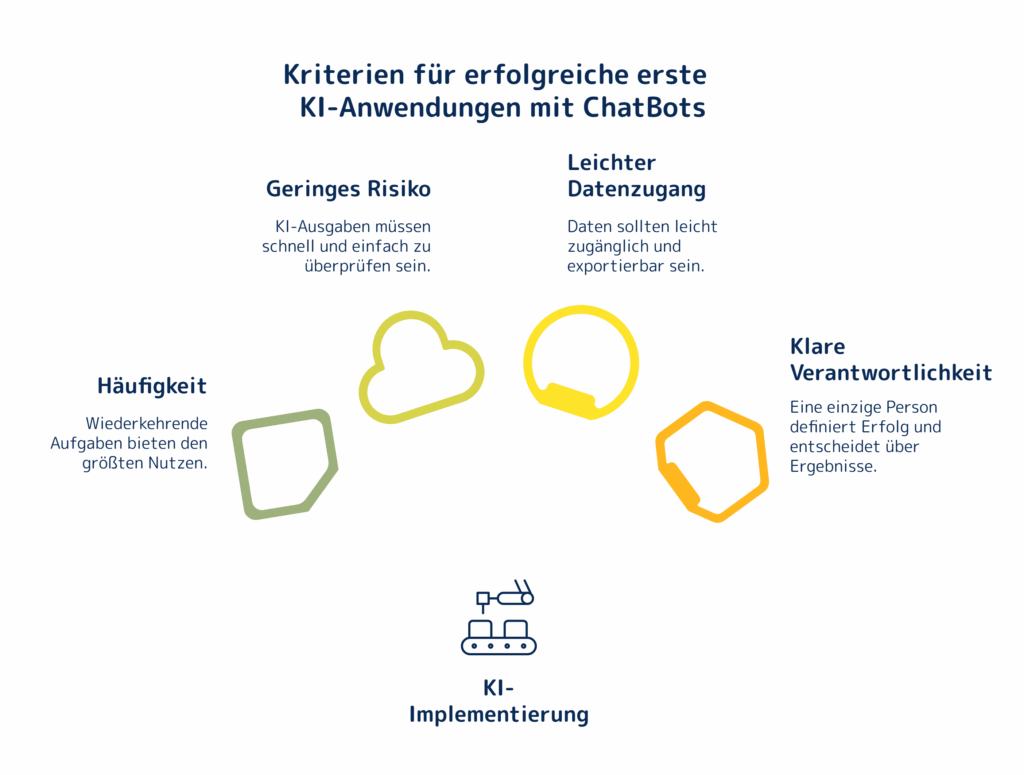
To get started successfully, you don’t need an in-depth analysis of all the possibilities for AI application in your company. It is sufficient to systematically identify which tasks are suitable for the beginning. A simple and pragmatic evaluation methodology can help here. You can use four criteria to assess whether a task is suitable for a small solution using a large language model (chatbots):
Frequency:
Recurring activities, ideally daily or weekly, offer the greatest benefit.
Low risk:
Every AI output must be able to be checked quickly – without in-depth expert judgement or complex consequences.
Easy data access:
If data can be provided via Excel, PDF or simple exports, there is no need for integration.
Clear responsibility:
A single person defines the criteria for success and decides on the outcome.
If you can answer ‘yes’ to all four points, you have an ideal starting point for a mini AI project.
The four-step plan: From idea to functioning AI application
Even the best idea will have no impact if it is not embedded in a structured approach. For small AI solutions, a lean, pragmatic four-step process is sufficient
Collect ideas – but stay focused
In a short workshop (45–60 minutes), collect activities that take up a lot of time and consist mainly of text, lists or formal communication. Teams from planning, purchasing and logistics can usually provide a long list within a few minutes.
It is important not to evaluate too early. Collect first, then select.
Evaluate and prioritise
The ideas can be quickly classified using the criteria mentioned above. Experience shows that two to four tasks usually emerge that offer a good balance between effort, risk and benefit. If you decide on just one pilot case, it can be tested as a prototype within a few days.
Result design – clarity before technology
In order for a chatbot to deliver meaningful results, it needs clear guidelines. These include:
What should the AI do?
Why is the result important?
What inputs are available?
What should the result look like (format, length, structure)?
What does the human check?
This improved ‘task description’ is usually the decisive step – significantly more important than the technical configuration.
Test, adapt, stabilise
A two-week mini pilot is perfectly adequate. A small user team processes a few real cases every day and evaluates:
Accuracy of the results
Comprehensibility
Time savings
Need for correction
Stability of the processes
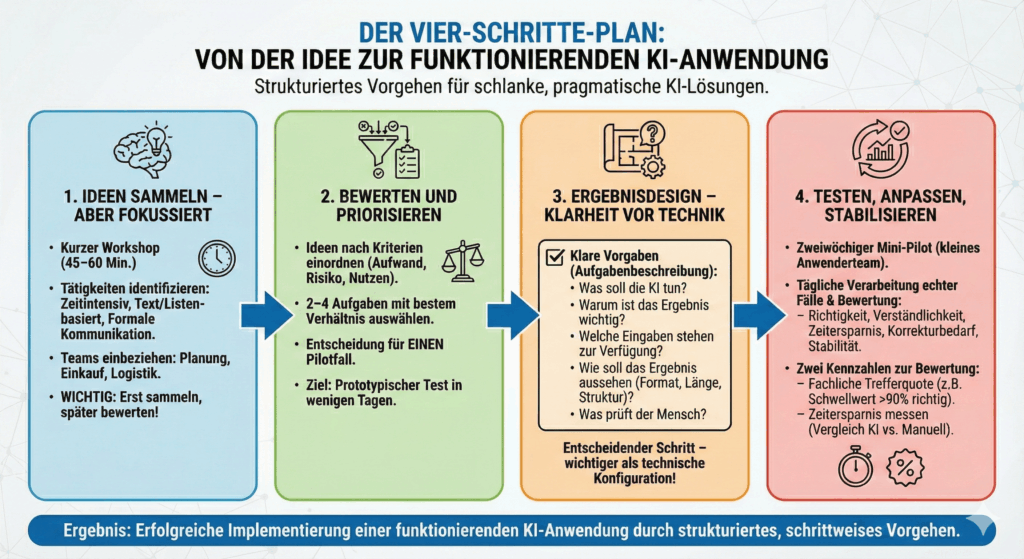
Two simple metrics help to evaluate the quality of the solution and the optimisation process. Assess the technical hit rate in each use case. Set a realistic threshold value for this, e.g. ‘90% correct’. Continue to try to measure the time savings. You will know how long the AI solution takes after implementation, and you can estimate from experience how long the work would have taken without AI.
If the result is convincing, the use case is continued. If not, either readjustments are made or another case is tried.
What the small introduction achieves – and what it deliberately does not aim to achieve
The focus on small AI solutions does not mean that ‘large’ solutions are dispensable. Forecasting models, optimisation procedures, decision support or autonomous planning approaches will play an important role in the long term. However, these require extensive preparatory work: stable data, clear processes, clear responsibilities.
The small entry point, on the other hand, offers three advantages:
Fast results: Noticeable relief after just a few days.
Learning curve for everyone involved: Teams experience how AI works and how to use it.
Reduction of risk and complexity: No dependence on IT, no system interventions, full control.
In short: Small solutions create the foundation on which large projects can function.
Conclusion
Starting with manageable, clearly defined use cases is therefore not a step backwards, but rather necessary groundwork. It reveals what AI can actually achieve in day-to-day management – and where its limitations lie. Above all, however, it creates a learning environment in which teams can gain experience, develop judgement and routinely integrate the use of new tools into their processes.
Only when this operational basis is in place can more complex AI projects be realistically planned and implemented. Small solutions do not replace large programmes, but they provide orientation, reduce friction and increase the chances of future projects being implemented. Those who choose this path take AI out of the realm of abstract vision and bring it to where its benefits can be immediately felt: in the everyday work of supply chain teams.
FAQ: Getting started with AI in supply chain management
Why do so many AI projects in companies fail?
Many AI projects fail because they are too large in scope and are expected to deliver immediate measurable economic benefits. High expectations, complex integration requirements and unclear data quality mean that pilot projects do not make it into operational use. Small, manageable use cases avoid this hurdle because they can be tested quickly and carry little risk.
Which simple AI applications really make a difference in everyday life?
Low-threshold tools such as chatbots or small LLM agents can take on tasks such as summarising emails, structuring exception lists or pre-formulating supplier enquiries. This often saves several hours per week and improves clarity in day-to-day business.
How can I find out which tasks are suitable for AI?
A rough four-criteria test is useful:
Is the task repeated frequently?
Is the risk low because the result is easily verifiable?
Is the data easily accessible, e.g. via Excel or PDF?
Is there a clear person responsible for the result?
If all the answers are ‘yes’, the task is a good place to start.
What are the risks associated with small AI projects?
The risks are limited because humans can check the results at any time and the systems do not require any intervention in IT infrastructures. The most important risk factors are data protection and the danger of accepting incorrect outputs without checking them. Paid, data protection-compliant AI tools significantly reduce this risk.
How much time do small AI solutions really save?
The savings vary, but often amount to several hours per week per employee. This is especially true for tasks that involve a lot of text and communication. The time savings can be easily measured in a pilot test by comparing the AI-supported processing time with the previous routine.
Do you need special software for AI in the supply chain?
Not for the first steps. Many applications can be tested with standard chatbots or generative AI tools. As long as the data can be provided from exports or Excel lists, no integration project is necessary. Larger software solutions only become relevant when it comes to forecasting models or optimisation processes.
How do I proceed with a small AI pilot project?
A pragmatic approach comprises four steps:
Collect ideas without evaluating them immediately.
Prioritise using simple criteria.
Clearly describe the task before starting the technical implementation.
Test for two weeks, evaluate the results and make adjustments.
This quickly produces a robust prototype.
Are small AI solutions just a temporary fix?
Above all, they are a necessary learning phase. Small solutions build trust, develop skills and quickly deliver initial relief. At the same time, they pave the way for larger AI initiatives that require stable data, clear responsibilities and realistic expectations. Without this operational entry point, ‘large’ AI programmes often remain theoretical.
